
Homeowners Insurance
Your home is more than the building itself. Homeowners insurance may help protect the dwelling, other structures, personal belongings, personal liability, and additional living expenses after certain covered losses.
Coverage varies by insurer, policy form, state, selected limits, endorsements, exclusions, deductible, and the circumstances of a loss.

What Does a Homeowners Policy Protect?
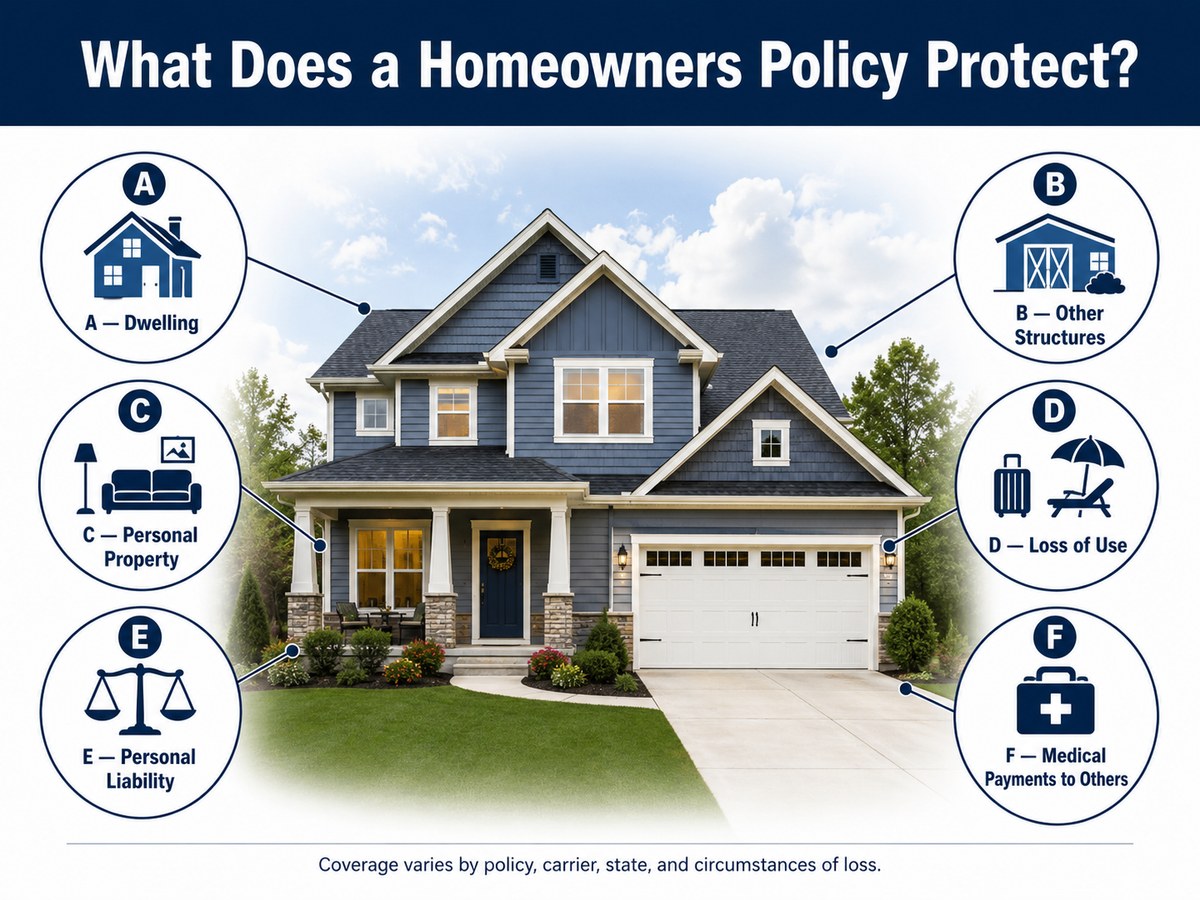
Homeowners insurance is designed for individuals and families who own and occupy their home. The following describes common coverage components typically found in a standard homeowners policy. Actual coverage in any specific loss depends on the policy form, selected coverages, carrier, applicable limits, exclusions, and the cause of loss.
Dwelling Coverage (Coverage A)
May cover certain direct physical loss or damage to the insured dwelling structure from covered perils — such as fire, lightning, windstorm, hail, and similar events listed in or not excluded from the policy — subject to the coverage form (open perils vs. named perils), applicable limits, exclusions, and deductible. The coverage limit should reflect the estimated cost to rebuild the structure at current construction costs, not the property's market value. These two figures are often different.
Other Structures (Coverage B)
May cover certain direct physical loss or damage to detached structures on the property — such as a detached garage, fence, shed, or pool — from covered perils, subject to policy terms, applicable limits, and exclusions. This coverage is typically a percentage of the dwelling limit. Confirm the amount with our team when reviewing a specific policy.
Personal Property (Coverage C)
May cover certain direct physical loss or damage to personal belongings — furniture, clothing, electronics, appliances, and similar items — from covered perils, subject to the policy's coverage form, applicable limits, sub-limits for specific item categories, exclusions, and deductible. High-value items such as jewelry, watches, fine art, musical instruments, cameras, and collectibles are commonly subject to per-item or per-category sub-limits under a standard policy. These items may require a scheduled endorsement for broader protection.
Loss of Use / Additional Living Expenses (Coverage D)
If a covered loss makes the insured residence temporarily uninhabitable, this coverage may help pay for certain additional living expenses — such as hotel costs or meals above what would normally be spent — while the home is being repaired or an alternate residence is established, subject to policy terms and applicable limits. Coverage requires that the additional expenses result from a covered loss. Not every temporary displacement is automatically eligible.
Personal Liability (Coverage E)
May cover the insured's covered legal liability for bodily injury or property damage to others arising from a qualifying incident — such as a guest injured on the property or property damage the insured causes elsewhere — subject to policy terms, applicable limits, and exclusions. Intentional acts, business-related liability, and certain specific activities or animal breeds may be excluded.
Medical Payments to Others (Coverage F)
May pay for certain medical expenses for guests injured on the insured property or by the insured's qualifying activities — regardless of fault — up to the policy's medical payments limit, subject to policy terms and eligibility. This coverage does not cover injuries to the insured or household members, and it is not a substitute for health insurance.

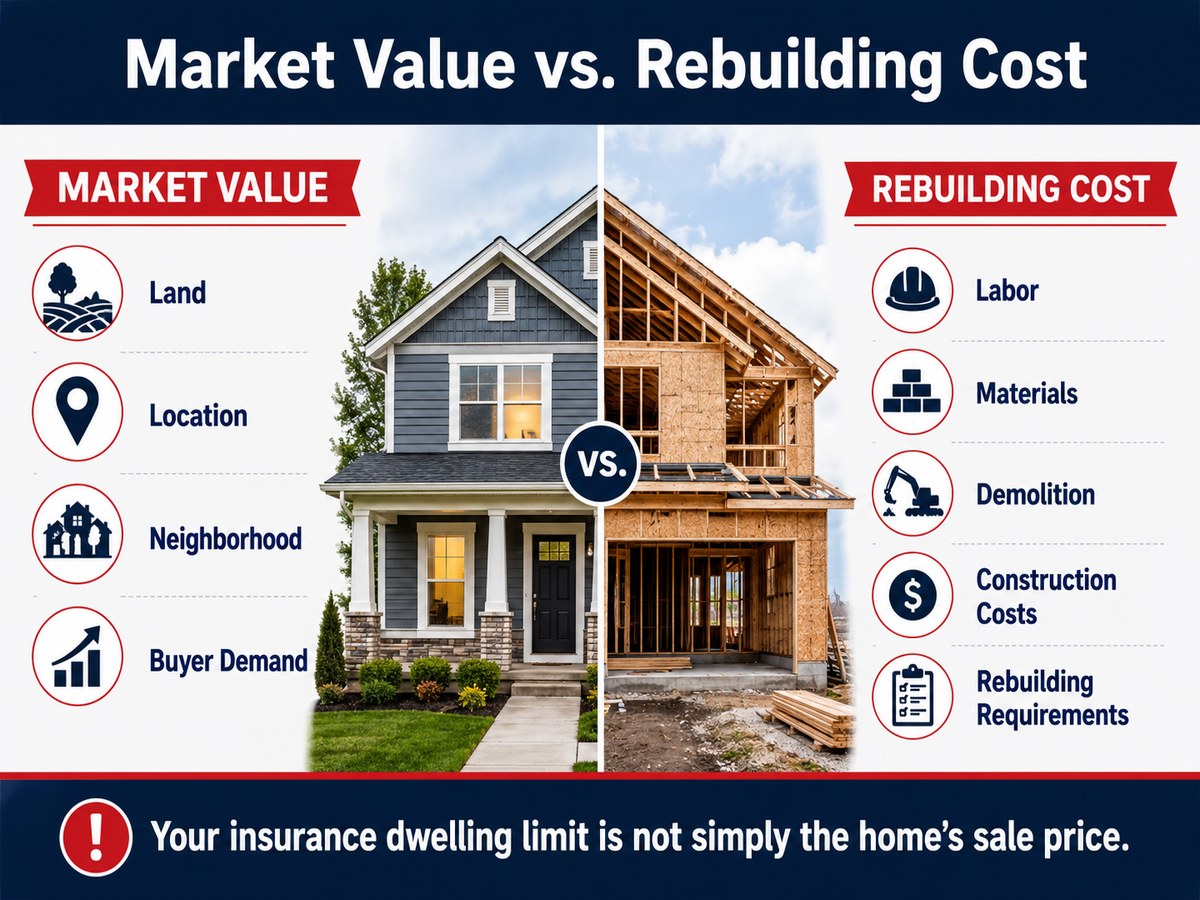
Rebuilding Cost Is Not the Same as Market Value
A home's market value reflects what a buyer would pay for the land and structure together, influenced by location, neighborhood, and buyer demand. Your dwelling coverage limit should instead reflect the estimated cost to rebuild the structure from the ground up at current labor and material costs — a figure that can be significantly higher or lower than market value.
If your dwelling limit is set too low relative to actual rebuilding cost, you may be underinsured in a total-loss scenario. Construction costs change over time, so a limit that was accurate at purchase may no longer reflect current rebuilding costs — particularly after regional cost increases or home renovations.
Review Your Dwelling Limit
Endorsements and Optional Coverages That May Be Available
Standard homeowners policies have significant limitations. The following endorsements or additional coverages may be available from some carriers — availability and terms vary by insurer and state.
Water Backup and Sump Overflow
Standard homeowners policies commonly exclude water damage that enters through sewers or drains or results from sump pump overflow. A water backup endorsement may cover certain losses from these specific causes, subject to its own terms, exclusions, and limits. Commonly recommended for homes with a basement or sump pump. Availability varies by carrier and state.
Equipment Breakdown
Standard homeowners policies typically exclude mechanical breakdown. An equipment breakdown endorsement may cover certain losses resulting from a mechanical or electrical breakdown of covered home systems and appliances — such as HVAC systems, water heaters, and refrigerators — from covered causes, subject to its own terms, limits, and exclusions.
Scheduled Personal Property
High-value items — jewelry, watches, fine art, musical instruments, cameras, collectibles, and similar valuables — are commonly subject to sub-limits under a standard homeowners policy. A scheduled personal property endorsement or floater may provide broader coverage for specifically listed items up to their scheduled value, often without a deductible and sometimes covering a wider range of perils.
Ordinance or Law Coverage
Following a covered loss requiring repair or rebuilding, local building codes may require bringing the structure up to current code standards — which can add significant cost beyond simply restoring it to its pre-loss condition. Ordinance or law coverage may help address certain costs resulting from enforcement of current building codes during a covered repair or rebuild, subject to its own terms, limits, and exclusions.
Service Line Coverage
May cover certain costs to repair or replace underground service lines — such as water, sewer, electrical, gas, or communication lines — running from the street to the home that are damaged by covered causes, subject to its own terms and limits. Standard policies typically do not cover service lines outside the home's foundation.
Identity Fraud Expense
Some carriers offer an identity fraud expense endorsement that may cover certain costs associated with responding to identity theft — such as legal fees, lost wages during recovery activities, or credit monitoring expenses — subject to the endorsement's terms, conditions, and limits. This is not a substitute for standalone identity theft insurance or monitoring services.
Extended or Increased Replacement Cost
May provide additional dwelling coverage above the policy's stated Coverage A limit — often a set percentage — if the cost to rebuild after a covered loss exceeds that limit, subject to the endorsement's own terms and conditions. This can help address unexpected cost increases in labor and materials at the time of a claim. Availability and the percentage offered vary by carrier.
Personal Injury Endorsement
Standard personal liability coverage generally addresses bodily injury and property damage. A personal injury endorsement may extend certain liability coverage to non-physical injuries such as libel, slander, or false arrest, subject to the endorsement's own terms, conditions, and exclusions. Availability varies by carrier.
Higher Personal Liability Limits
Standard personal liability limits may be inadequate depending on your assets and exposure. Some carriers allow increasing the personal liability and medical payments limits within the homeowners policy itself; broader excess protection may also be available through a separate personal umbrella policy.
What Standard Homeowners Policies Commonly Do Not Cover
These exclusions are common across many homeowners policies. Exclusions vary by insurer, policy form, and state — review the actual policy form for your coverage.
- Flood damage: Standard homeowners policies generally do not cover damage caused by flooding — including storm surge, overflowing water bodies, and surface water accumulation from heavy rain. Flood coverage typically requires a separate policy through the National Flood Insurance Program (NFIP) or a private flood insurer
- Earthquake damage: Earthquake damage is generally excluded from standard homeowners policies. Separate earthquake coverage or an endorsement may be available depending on the state and carrier
- Normal wear and tear, settling, shrinking, bulging, or gradual deterioration
- Mold, rot, and fungus — coverage varies significantly by policy; often limited or excluded, particularly when resulting from a maintenance issue or slow leak rather than a sudden covered event
- Home-based business: Business property, business liability, and professional liability arising from business activities conducted at home are generally not covered under a standard homeowners policy
- Intentional acts or criminal acts by the insured
- Certain dog breeds or animal types may be excluded from personal liability coverage depending on the carrier's underwriting guidelines
Situations That Require Attention
- Replacement cost vs. actual cash value: A replacement-cost policy may pay to repair or rebuild with like materials without deducting for depreciation, subject to policy terms and limits. An actual-cash-value policy pays the depreciated value at the time of loss. Understand which valuation method applies to both the dwelling and personal property before selecting a policy
- Deductibles: Some policies have separate deductibles for wind, hail, or hurricane damage — often a percentage of the dwelling limit rather than a flat dollar amount. Review all deductible provisions carefully
- Vacancy: Most homeowners policies restrict or suspend certain coverages if the home is vacant beyond a specified period (commonly 30 to 60 days). If a property will be unoccupied for an extended period, notify our team in advance
- Dwelling-limit adequacy: Construction costs change over time. A dwelling limit set at the time of purchase may not keep pace with current rebuilding costs. Review your coverage limit periodically and after significant renovations or additions
- Renovations: Additions, finished basements, and major upgrades can increase rebuilding cost and personal property value — notify our team after significant renovations so your coverage limits can be reviewed
- Home-based business: If you operate a business from your home, standard coverage may be limited or excluded — a home business endorsement or separate business policy may be needed
- Renting out your home: Using a home as a full-time or partial rental — including short-term platforms — generally falls outside a standard owner-occupied homeowners policy. Learn About Landlord Insurance →
Homeowners Insurance FAQs
Does homeowners insurance cover flood damage?
Generally, no. Standard homeowners insurance policies exclude flood damage — including damage caused by storm surge, overflowing rivers or lakes, and surface water accumulation from heavy rain. Flood coverage typically requires a separate policy through the National Flood Insurance Program (NFIP) or a private flood insurer. Depending on the property, loan, lender, and applicable flood-insurance requirements, separate flood insurance may be required for properties in certain higher-risk flood areas. Contact our team to discuss whether separate flood coverage is appropriate for your property location.
What is the difference between rebuilding cost and market value?
Market value reflects what a buyer would pay for the land and home together, influenced by location, neighborhood, and buyer demand. Rebuilding cost reflects what it would cost to reconstruct the structure from the ground up at current labor and material costs — including demolition and rebuilding requirements. Your dwelling coverage limit should be based on rebuilding cost, not market value. The two figures are frequently different, sometimes significantly.
What is the difference between replacement cost and actual cash value?
Replacement cost coverage may pay to repair or replace a covered item with a comparable new one — subject to policy terms and applicable limits — without deducting for depreciation. Actual cash value (ACV) coverage pays the depreciated value of the item at the time of loss, reflecting age, condition, and wear. Replacement-cost policies typically carry higher premiums. For homeowners policies, the valuation method applies to both the dwelling and personal property — confirm how both are treated in any policy you are reviewing.
Does homeowners insurance cover a home-based business?
Standard homeowners insurance generally has significant limitations for business activities conducted from the home. Business personal property — inventory, specialized equipment, business electronics — is commonly subject to low sub-limits or excluded. Business liability is generally excluded from the homeowners policy's personal liability coverage. If you operate a business from your home, you may need a home business endorsement, a business owner's policy (BOP), or separate professional liability coverage, depending on the nature and scale of your business.
Is earthquake damage covered by a standard homeowners policy?
Generally, no. Earthquake damage is excluded from most standard homeowners insurance policies. Separate earthquake coverage may be available as an endorsement or a standalone policy from some carriers, depending on the state and property location. Contact our team to discuss whether earthquake coverage is available and appropriate for your property.
Can I rent out my home if I have a standard homeowners policy?
Standard homeowners policies are designed for owner-occupied residences. Renting out your home full-time, listing it on a short-term rental platform, or renting out part of it may require a different policy form or endorsement — coverage under a standard homeowners policy may be limited or excluded for rental activities. See our Landlord Insurance page or contact our team before renting out any part of your home.
What states does Whitestone Insurance serve for homeowners insurance?
Whitestone Insurance Services LLC is licensed in New York, New Jersey, Connecticut, Pennsylvania, Ohio, Delaware, and South Carolina. Our ability to place homeowners coverage depends on the property location, risk details, carrier availability, and applicable state requirements. Contact us to confirm availability and discuss options for your state and property type.
Ready to Review Your Homeowners Coverage?
Call us or start a quote request online. Our licensed agents provide personal guidance through the review process.