
Landlord Insurance
Protection for Rental Property Owners
A property rented to others generally creates different insurance exposures than an owner-occupied residence. Landlord insurance is designed for rental-property risks and may help protect the building, certain landlord-owned property, qualifying rental income after a covered loss, and the landlord's liability exposure.
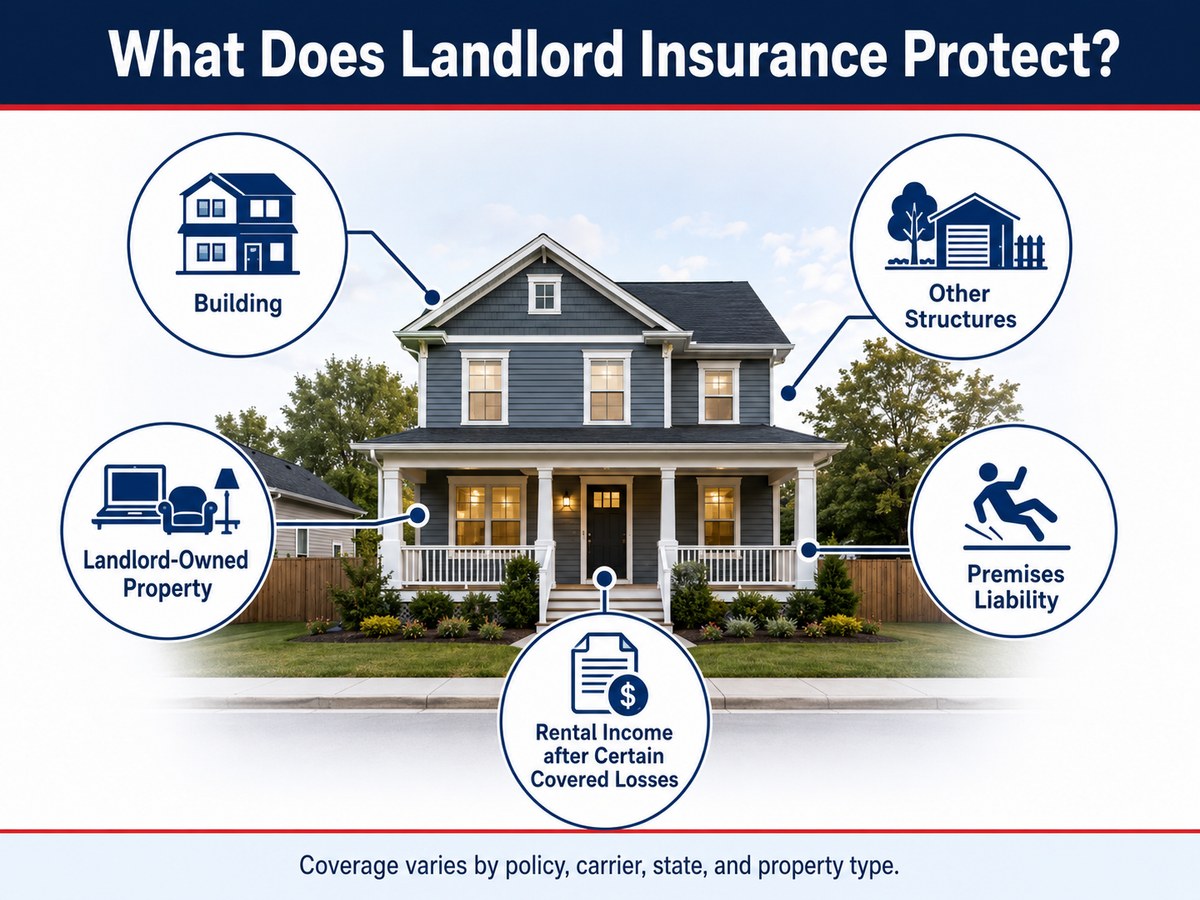
What Does Landlord Insurance Protect?
Landlord insurance is designed for individuals who own residential property that is rented to tenants rather than occupied by the owner. The following describes common coverage components. Actual coverage in any specific loss depends on the policy form, selected coverages, carrier, applicable limits, exclusions, and the cause of loss.
Dwelling / Building Coverage
May cover certain direct physical loss or damage to the insured rental structure from covered perils — such as fire, lightning, windstorm, and hail — subject to the coverage form, applicable limits, exclusions, and deductible. The coverage limit should reflect the estimated cost to rebuild the structure, not its market value.
Other Structures
May cover certain direct physical loss or damage to detached structures on the rental property — such as a detached garage, fence, or shed — from covered perils, subject to policy terms, applicable limits, and exclusions.
Landlord-Owned Property
May cover certain direct physical loss or damage to property the landlord owns and keeps on the premises for maintenance or tenant use — such as appliances, furnishings in a furnished rental, or maintenance equipment — subject to policy terms, applicable limits, and exclusions. This does not extend to property owned by the tenant.
Loss of Rental Income / Fair Rental Value
If a covered loss makes the rental unit temporarily uninhabitable, this coverage may help reimburse the landlord for the fair rental value lost while the unit is being repaired, subject to policy terms, applicable limits, and the requirement that the loss of income results from a covered loss. This coverage is not a substitute for rent-default or eviction protection — see the important distinction below.
Premises Liability
May cover the landlord's covered legal liability for bodily injury or property damage to others arising from a qualifying incident at the rental property — such as a tenant or visitor injured due to a covered premises condition — subject to policy terms, applicable limits, and exclusions.
Medical Payments to Others
May pay for certain medical expenses for a tenant's guest or visitor injured at the rental property — regardless of fault — up to the policy's medical payments limit, subject to policy terms and eligibility. Intended for minor, incidental injuries; not a substitute for health insurance.

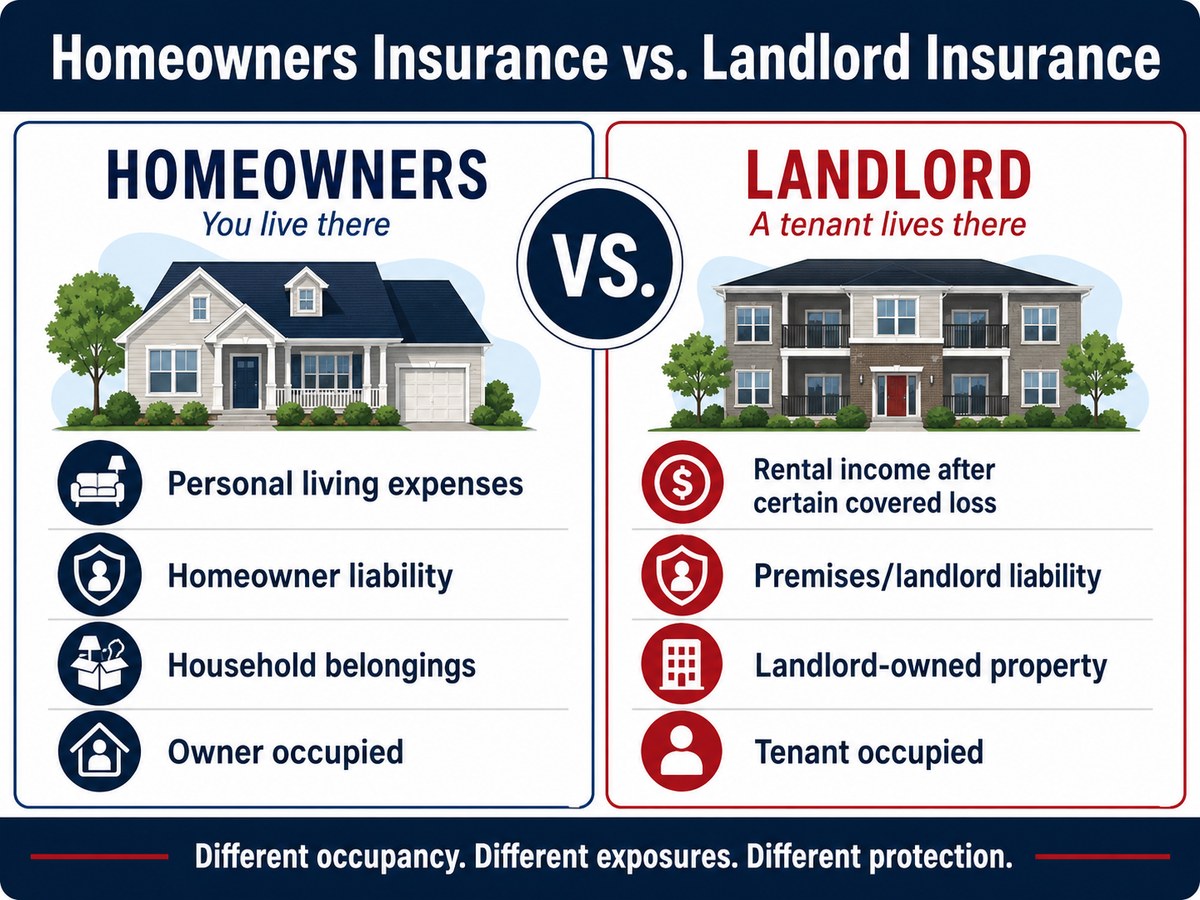
Homeowners Insurance vs. Landlord Insurance
A standard homeowners policy is built around owner occupancy. Once a property is rented to a tenant, the exposures change — and a homeowners policy generally is not designed to address them.
| Comparison Point | Homeowners Insurance | Landlord Insurance |
|---|---|---|
| Primary occupancy | Owner lives in the home | A tenant lives in the home |
| Building protection | Dwelling coverage for owner-occupied structure | Dwelling/building coverage for a rented structure |
| Owner personal property | Broad coverage for the owner's household belongings | Limited to landlord-owned property left on premises, not tenant belongings |
| Liability | Personal liability for the owner-occupant's household | Premises/landlord liability arising from the rental relationship |
| Loss after covered displacement | Additional living expenses for the owner-occupant | Fair rental value / loss of rental income for the landlord |
| Tenant belongings | Not applicable | Not covered — tenant needs a separate renters policy |

Landlord Insurance for Different Rental Situations
Rental property comes in many forms, and the appropriate coverage approach can vary by situation.

Single-Family Rental
A tenant-occupied single-family home may be eligible for a landlord or dwelling-fire policy form, depending on occupancy, property characteristics, carrier, state, and underwriting.

2–4 Family Property
Small multifamily properties with two to four units are commonly eligible for landlord or dwelling-fire policies, though carrier appetite and policy forms vary by unit count and owner-occupancy status.

Owner-Occupied Multifamily
When an owner lives in one unit of a multifamily property and rents the others, coverage may combine homeowners-style protection for the owner's unit with landlord-style protection for the rented units, depending on the carrier and policy form.

Rental Condo
A condo unit rented to a tenant may require landlord-oriented condo/unit-owner coverage or an endorsement, depending on the association master policy, carrier, occupancy, and underwriting.

Short-Term Rental
Listing a property on a short-term rental platform (such as Airbnb or VRBO) generally should not be assumed to be automatically covered under a standard landlord policy. Short-term and vacation-rental exposures often require a specific endorsement or a specialized policy — contact our team before listing a property short-term.

Vacant or Renovating Property
Landlord policies commonly restrict or exclude certain coverages once a property has been vacant beyond a specified period, and renovation activity can introduce additional exposures. Notify our team before a property sits vacant or undergoes significant renovation.
When a Rental Property Becomes a Commercial Insurance Risk
As a rental portfolio grows — more units, larger multifamily buildings, or mixed residential/commercial use — the risk may exceed what a standard landlord policy is designed to address, and a commercial property or commercial package policy may become more appropriate.
Holding a property in an LLC or other business entity does not, by itself, automatically make a risk commercial for insurance purposes — the determination generally depends on factors such as unit count, building size and use, and the carrier's underwriting guidelines, not entity structure alone. Contact our team to review whether your rental property or portfolio is best suited to a landlord policy or a commercial policy.
Loss of Rental Income Is Not the Same as Rent Guarantee
Coverage for qualifying rental income may apply when a covered insured loss makes the property uninhabitable. Traditional landlord property insurance should not be assumed to pay simply because a tenant stops paying rent.
Traditional landlord property insurance addresses loss of rental income only when a covered peril makes the unit uninhabitable — such as fire or wind damage. It generally should not be assumed to reimburse a landlord for rent in the case of tenant nonpayment, a broken lease, or an eviction. Those situations are financial and legal in nature, not property-damage events, and are typically outside the scope of a standard landlord property policy. Separate rent-guarantee or rent-default products may exist in some markets and are distinct from landlord property insurance. Availability varies.
What Landlord Insurance Generally Does Not Protect
Exclusions vary by insurer, policy form, and state — review the actual policy form for your coverage.
- Tenant belongings: A landlord policy does not cover the tenant's personal property — the tenant needs a separate renters policy
- Tenant liability: A landlord policy addresses the landlord's liability, not liability the tenant may carry as an occupant
- Normal wear and tear, gradual deterioration, and routine maintenance issues
- Flood and earthquake damage: Generally excluded unless separately insured through the NFIP, a private flood insurer, or an earthquake endorsement
- Tenant nonpayment of rent: Standard landlord property insurance generally does not reimburse rent lost to tenant nonpayment, lease breaks, or eviction — see the distinction above
- Intentional acts or criminal acts by the insured
Your Tenant Still Needs Their Own Insurance
Because a landlord policy does not cover tenant belongings or tenant personal liability, many landlords require tenants to carry their own renters insurance as a condition of the lease. This can help reduce disputes after a loss and gives tenants their own path to recovering their belongings.
Learn About Renters Insurance →Endorsements and Optional Coverages That May Be Available
Availability and terms vary by insurer and state.
Water Backup and Sump Overflow
May cover certain losses from water that enters through sewers or drains or results from sump pump overflow, subject to its own terms, exclusions, and limits. Commonly recommended for properties with a basement or sump pump.
Ordinance or Law Coverage
May help address certain costs resulting from enforcement of current building codes during a covered repair or rebuild, subject to its own terms, limits, and exclusions.
Service Line Coverage
May cover certain costs to repair or replace underground service lines running from the street to the rental property that are damaged by covered causes, subject to its own terms and limits.
Equipment Breakdown
May cover certain losses resulting from a mechanical or electrical breakdown of covered building systems and appliances, subject to its own terms, limits, and exclusions.
Vandalism Coverage
May help address certain damage caused by vandalism or malicious mischief, which can be a more significant exposure for vacant or between-tenant units, subject to policy terms and limits.
Extended Replacement Cost
May provide additional building coverage above the policy's stated limit if the cost to rebuild after a covered loss exceeds that limit, subject to the endorsement's own terms and conditions.
Landlord Furnishings Coverage
For furnished rentals, may extend broader coverage for landlord-owned furniture, appliances, and fixtures provided to tenants, subject to its own terms and limits.
Increased Liability Limits / Umbrella
Standard premises liability limits may be inadequate depending on the property and exposure. Some carriers allow increasing liability limits within the landlord policy itself; broader excess protection may also be available through a separate personal or commercial umbrella policy, depending on the ownership structure.
Landlord Insurance FAQs
Can I just keep my homeowners policy after renting out my property?
Generally, no. Standard homeowners policies are designed for owner-occupied residences. Once a property is rented to a tenant, the occupancy and risk profile change, and coverage under a standard homeowners policy may be limited or excluded for rental activities. A landlord policy is designed specifically for rental-property exposures.
Does landlord insurance cover my tenant's belongings?
No. A landlord policy covers the building and, in some cases, landlord-owned property left on the premises — it does not cover the tenant's personal belongings. Tenants need their own renters insurance policy to protect their belongings and personal liability.
Does landlord insurance pay my rent if a tenant stops paying?
Generally, no. Standard landlord property insurance addresses loss of rental income only when a covered peril, such as fire or wind damage, makes the unit uninhabitable. It generally should not be assumed to reimburse rent for tenant nonpayment, a broken lease, or an eviction — those are separate financial and legal exposures, not property-damage events.
Is my short-term rental (Airbnb/VRBO) automatically covered?
Standard landlord coverage should not be assumed to automatically cover short-term or vacation-rental activity. Listing a property on a short-term rental platform often requires a specific endorsement or a specialized short-term rental policy. Contact our team before listing a property short-term to review your options.
What happens if my rental property sits vacant?
Landlord policies commonly restrict or suspend certain coverages if a property is vacant beyond a specified period. If a rental unit will be vacant for an extended time — between tenants or during renovation — notify our team in advance to understand the implications for your coverage.
Does owning a rental property through an LLC make it a commercial risk?
Not automatically. Holding a property in an LLC or other business entity does not by itself make a risk commercial for insurance purposes. The determination generally depends on factors such as unit count, building size and use, and carrier underwriting guidelines. Contact our team to review whether a landlord or commercial policy best fits your specific property or portfolio.
What is the difference between a landlord policy and a commercial property policy?
Landlord policies are generally designed for smaller residential rental exposures, such as single-family homes or small multifamily buildings. As a rental portfolio grows in size, unit count, or complexity — or includes mixed residential/commercial use — a commercial property or commercial package policy may become more appropriate. Contact our team to discuss which structure fits your situation.
Should I require my tenants to carry renters insurance?
Many landlords choose to require tenants to carry renters insurance as a condition of the lease. Because a landlord policy does not cover tenant belongings or tenant liability, requiring renters insurance can help reduce disputes after a loss and gives tenants their own path to recovering their belongings. This is a lease decision — confirm with legal counsel whether and how to require it in your state.
Does landlord insurance cover flood or earthquake damage?
Generally, no. Standard landlord insurance policies exclude flood and earthquake damage. Separate flood coverage may be available through the National Flood Insurance Program (NFIP) or a private flood insurer, and separate earthquake coverage may be available depending on the carrier and state.
What states does Whitestone Insurance serve for landlord insurance?
Whitestone Insurance Services LLC is licensed in New York, New Jersey, Connecticut, Pennsylvania, Ohio, Delaware, and South Carolina. Our ability to place landlord coverage depends on the property location, risk details, carrier availability, and applicable state requirements. Contact us to confirm availability and discuss options for your state and property type.
Ready to Review Your Landlord Coverage?
Call us or start a quote request online. Our licensed agents provide personal guidance through the review process.