
Social Security Education & Planning
Social Security can be one of the most important sources of retirement income. Understanding when to claim, how family benefits work, how employment affects benefits, and how Social Security fits with Medicare and other retirement income can help you make a more informed decision. A Social Security claiming decision can have long-term consequences, so understanding your options before filing matters.

Guidance From a Registered Social Security Analyst®
David Gulishvili has completed specialized Social Security education and earned the Registered Social Security Analyst® (RSSA®) credential. David helps clients understand claiming choices and how those choices may interact with retirement income, spousal and survivor planning, work decisions, Medicare timing, and other retirement considerations.
RSSA® is an independent professional credential and does not imply affiliation with or endorsement by the Social Security Administration or any government agency.
A Claiming Decision With Long-Term Consequences
Social Security is often one of the largest and most reliable sources of retirement income, but the age at which you claim it can affect your monthly benefit for the rest of your life. Claiming early generally reduces your benefit; waiting generally increases it — and the "right" answer is different for every household.
The decision also affects more than just your own check. It can influence what a spouse or survivor may receive, how much of your benefit is subject to federal income tax, whether working while receiving benefits temporarily reduces your payments, and how your claiming strategy fits with Medicare enrollment and your broader retirement income plan.
Because these choices carry long-term consequences, reviewing your options before you file is one of the most valuable steps you can take heading into retirement.
Limited options may exist after filing, such as withdrawing an application within SSA's permitted time period or voluntarily suspending retirement benefits after Full Retirement Age. These options have specific rules and should not be viewed as substitutes for planning before filing.
Support Through Every Stage of the Claiming Decision
When Should I Claim?
Review how claiming at different ages may affect your lifetime benefit and overall retirement income plan.
Full Retirement Age
Understand your personal Full Retirement Age based on your birth year and what it means for your benefit amount.
Spousal Benefits
Review how spousal benefits may apply to your household's situation.
Divorced-Spouse Benefits
Understand whether benefits based on a former spouse's record may be available.
Survivor Benefits
Understand how survivor benefits generally work and how they may factor into a household's planning.
Working While Receiving Benefits
Understand how earnings before Full Retirement Age may temporarily affect benefits under SSA's retirement earnings test.
Social Security Statement Review
Walk through your Social Security Statement together so the numbers make sense in the context of your plan.
Medicare & Social Security Timing
Review how Social Security timing may relate to Medicare enrollment and your broader retirement income sources.
Public Pension / WEP-GPO Changes
Understand how the recent repeal of WEP and GPO may affect certain public-sector and pension situations.
Preparing to Apply
Help you understand what to expect and what to gather before you file directly with SSA.
Existing Benefit Review
Review an existing claiming decision and whether any limited after-filing options may be relevant.
The goal is to help you understand the questions and tradeoffs before you make an important filing decision. Official applications, benefit calculations, eligibility determinations, and final decisions are made by the Social Security Administration.
How Social Security Retirement Benefits Work
Work Credits and Retirement Eligibility
Most workers need 40 Social Security credits to qualify for retirement benefits based on their own work record. The amount of earnings required for a credit can change annually. In 2026, one credit is earned for each $1,890 of covered earnings, up to four credits for the year. (2026 figure — subject to annual change.)
What Is Full Retirement Age?
Your Full Retirement Age (FRA) is the age at which you're eligible for 100% of your Primary Insurance Amount — your unreduced retirement benefit. FRA depends on your birth year. For people born in 1960 or later, Full Retirement Age is 67 under current law. People born 1943–1954 have an FRA of 66, with a gradual two-month-per-year increase for those born 1955–1959. Your specific FRA should be confirmed with SSA.
How Your Social Security Retirement Benefit Is Calculated
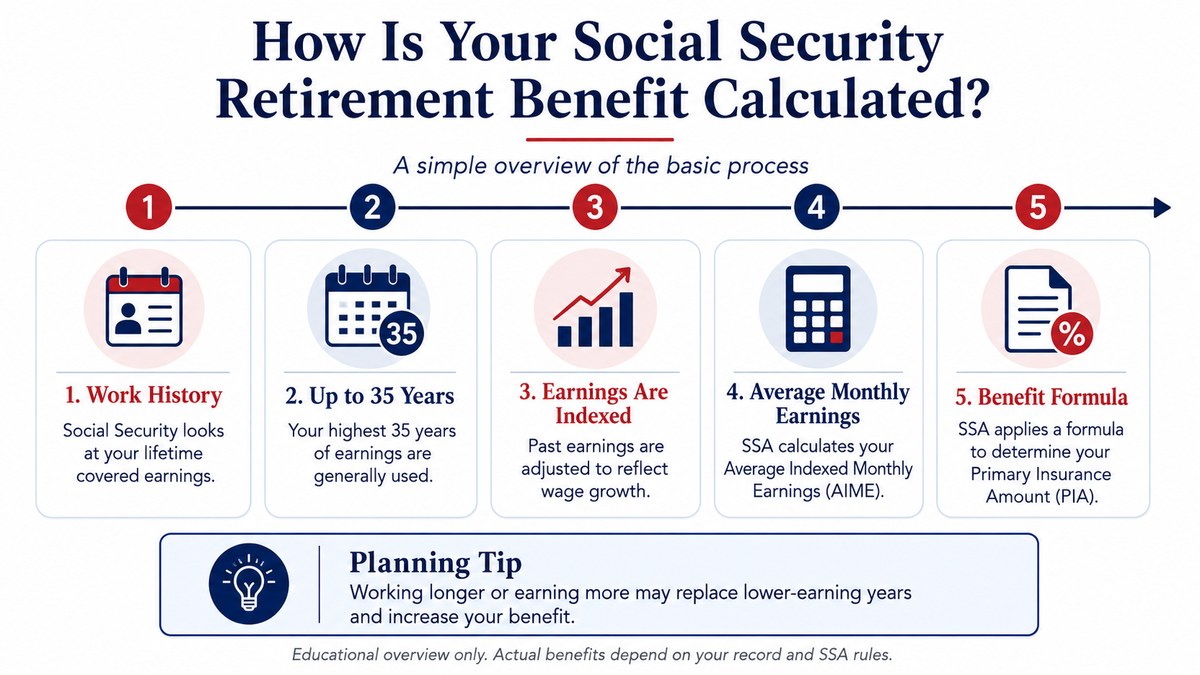
Social Security retirement benefits are based on your covered earnings history. SSA generally uses up to 35 years of indexed earnings when calculating your retirement benefit. If you have fewer than 35 years of covered earnings, years with no covered earnings can reduce the average used in the calculation.
Continuing to work can sometimes increase a future retirement benefit when a new year of covered earnings replaces a lower-earning year in the calculation.
SSA converts the applicable earnings record into Average Indexed Monthly Earnings (AIME) and applies the Social Security benefit formula to determine the worker's Primary Insurance Amount (PIA), which is generally the retirement benefit payable at Full Retirement Age before other adjustments.

Your Social Security Statement provides personalized estimates based on your actual earnings record. This page does not attempt to calculate a personalized benefit estimate — SSA's own statement and tools are the authoritative source for your specific numbers.
Claiming at 62 vs. Full Retirement Age vs. 70
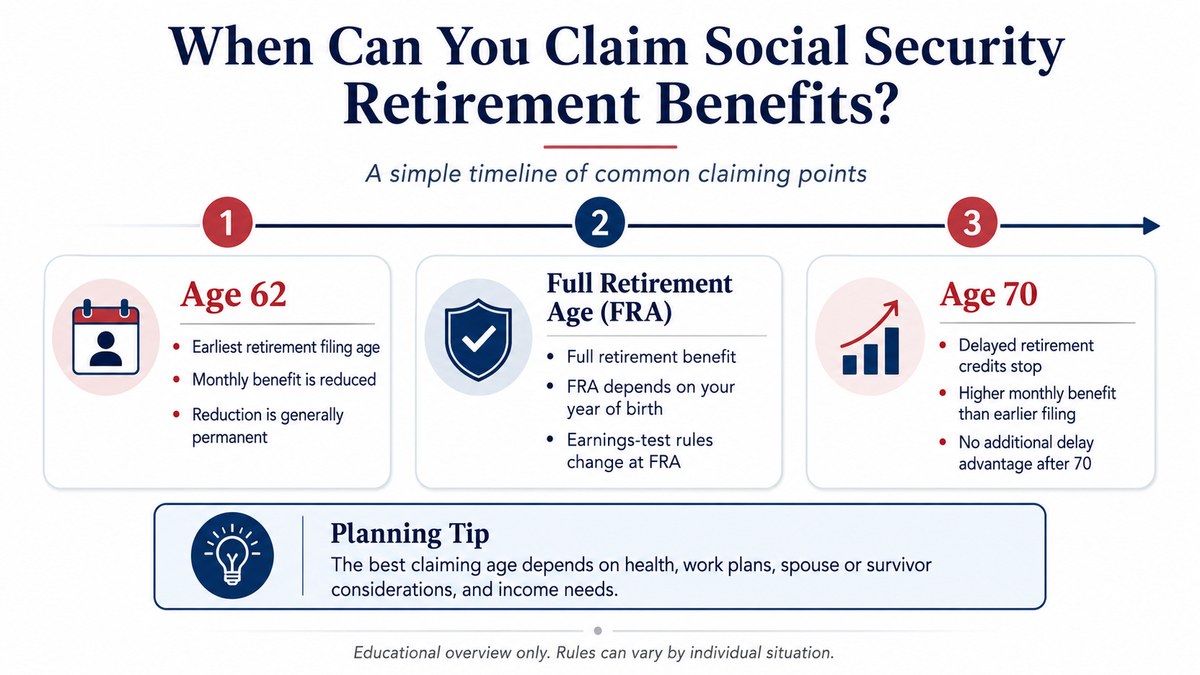
Claiming before FRA generally reduces the monthly retirement benefit. Filing at FRA generally provides 100% of your Primary Insurance Amount. Delaying after FRA can earn delayed retirement credits, but those credits stop at age 70.

Age 62 is the earliest age most people can begin retirement benefits, but claiming before Full Retirement Age generally results in a lower monthly retirement benefit. Delaying beyond FRA can increase the worker's retirement benefit through delayed retirement credits, but those credits stop at age 70.
Claiming at 62
Provides income sooner but generally results in a permanently reduced monthly benefit compared to waiting until FRA. May be appropriate depending on health, other income sources, and household circumstances — but the reduction lasts for life.
Claiming at Full Retirement Age
Provides your unreduced benefit amount — 100% of your Primary Insurance Amount — as calculated by SSA.
Delaying to Age 70
Generally results in the highest possible monthly benefit through delayed retirement credits, but requires other income to bridge the years between retirement and claiming. Delayed retirement credits stop accruing at age 70.
Spousal Benefits
A spouse may qualify for benefits based partly on a worker's Social Security record. At the spouse's Full Retirement Age, the maximum spousal amount can generally be up to 50% of the worker's Primary Insurance Amount, subject to eligibility and coordination rules.
Older claiming strategies such as file-and-suspend or a restricted application are not broadly available under current law. Whether any variation may still apply to your specific situation should be confirmed with SSA.
Can I Receive Benefits Based on an Ex-Spouse's Record?
A divorced person may potentially qualify for benefits based on a former spouse's record if the marriage lasted at least 10 years and other SSA requirements are satisfied.
- Age requirements apply
- Marital-status rules apply
- Additional SSA conditions apply
- An ex-spouse's claim generally does not reduce the worker's or current spouse's benefit
Independently-entitled divorced-spouse rules can be more complex than this summary — including situations where the worker has not yet filed. A personal review can help clarify whether these rules may apply to you.
Survivor Benefits
Survivor benefits follow different rules from regular spousal benefits and can be an important part of retirement planning for married and formerly married individuals.
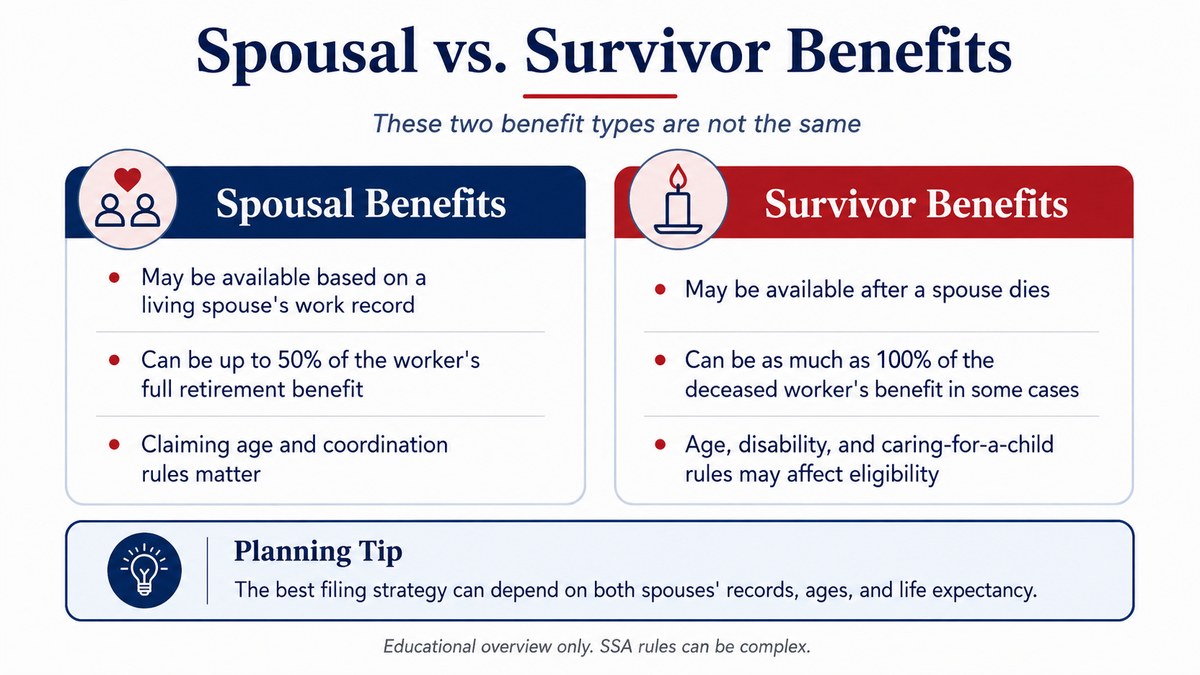
Spousal Benefits
May be available based on a living spouse's work record — up to 50% of the worker's FRA amount.
Survivor Benefits
May become available after a spouse or qualifying former spouse dies — potentially up to 100% of the deceased worker's benefit in some cases.

These benefit types should not be confused. Spousal benefits generally apply while both spouses are alive, while survivor benefits may become available after a spouse or qualifying former spouse dies. Different age and filing rules apply.
Because a surviving spouse's benefit is tied to the deceased worker's benefit amount, the higher-earning spouse's claiming decision may have survivor implications — an earlier claim by the higher earner can mean a smaller benefit is available to the survivor later.
Can I Work and Receive Social Security at the Same Time?
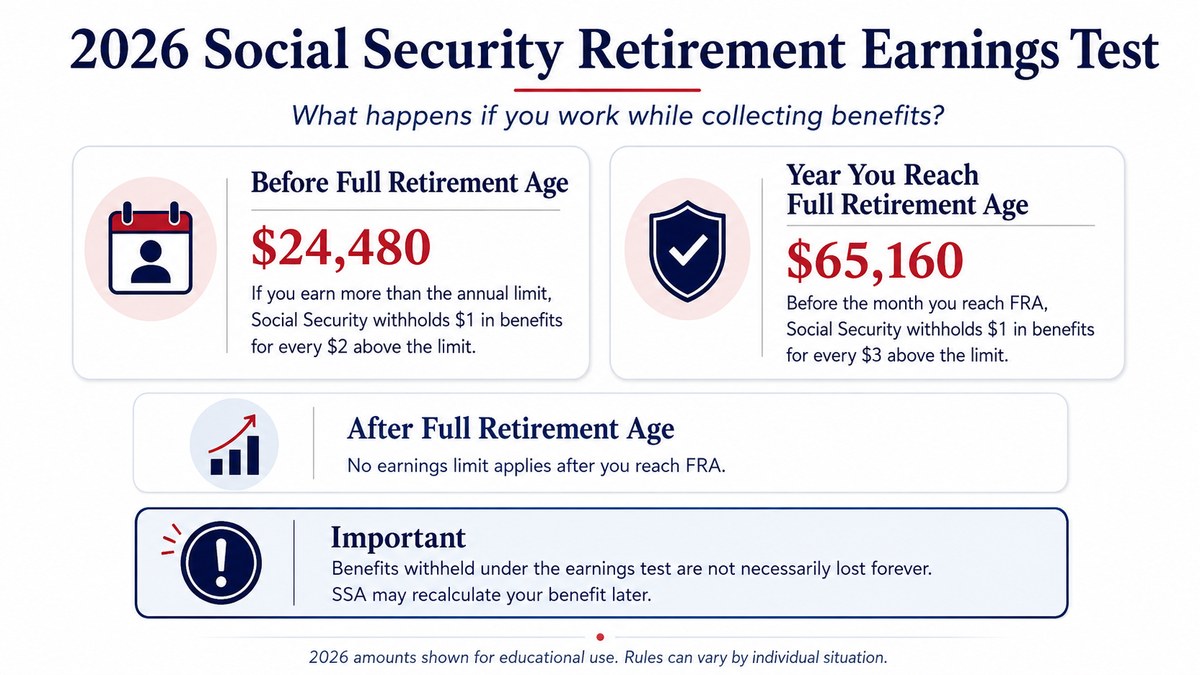
Yes. But if you receive retirement benefits before Full Retirement Age and continue working, the retirement earnings test may temporarily affect benefit payments.
Under FRA for All of 2026
Annual limit: $24,480. SSA generally withholds $1 in benefits for every $2 of earnings above the annual limit.
During the Year You Reach FRA
Limit: $65,160. SSA generally withholds $1 for every $3 earned above the applicable limit before the month FRA is reached.
Beginning With FRA Month
The retirement earnings-test limit no longer applies.

Important Update for Some Public-Sector and Pension Workers
The Social Security Fairness Act repealed the Windfall Elimination Provision (WEP) and Government Pension Offset (GPO). Those rules previously reduced Social Security benefits for some people who also received pensions from employment not covered by Social Security.
The repeal applies to Social Security benefits payable for months after December 2023. This can be important for certain teachers, police officers, firefighters, government employees, and people receiving certain pensions from non-covered employment.
Will My Social Security Benefits Be Taxed?
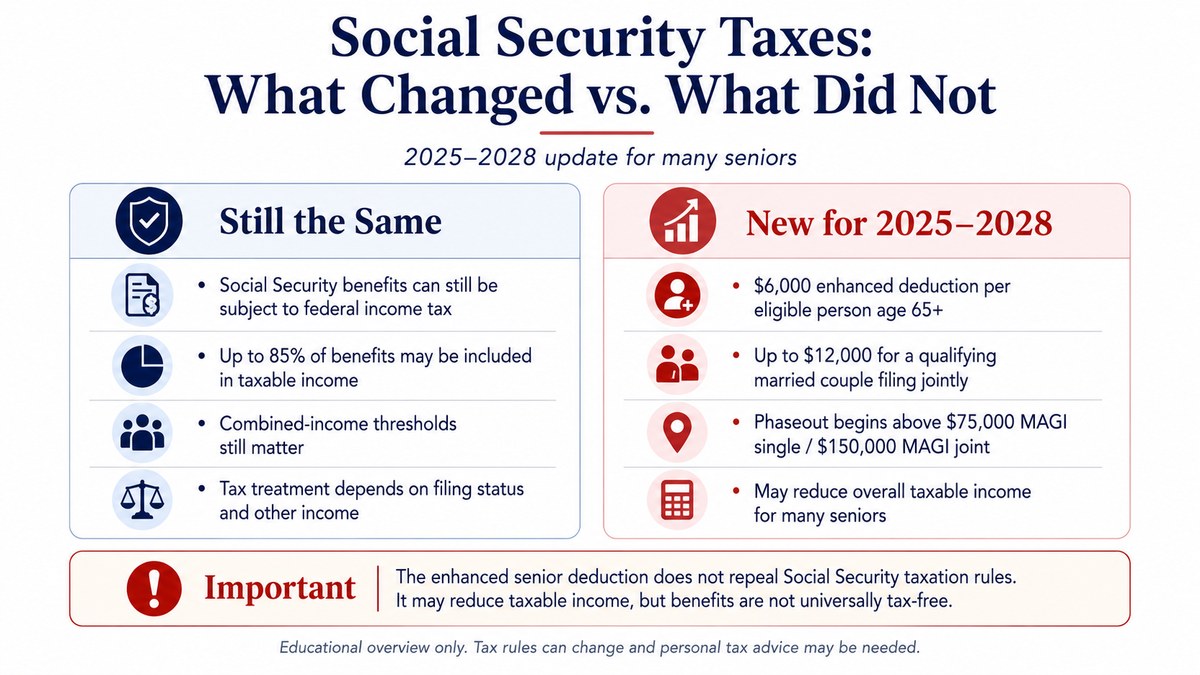
Social Security benefits can still be subject to federal income tax depending on combined income and filing status. Under current federal rules, up to 85% of Social Security benefits may be included in taxable income for some taxpayers.
Single
- Below $25,000: generally no federal income tax on benefits
- $25,000–$34,000: up to 50% may be taxable
- Above $34,000: up to 85% may be taxable
Married Filing Jointly
- Below $32,000: generally no federal income tax on benefits
- $32,000–$44,000: up to 50% may be taxable
- Above $44,000: up to 85% may be taxable
These thresholds are set by federal law and are not adjusted for inflation. State tax treatment varies. This is general information, not tax advice — consult a qualified tax professional for guidance specific to your return.
New Senior Deduction for 2025–2028
Federal tax law added a temporary enhanced deduction for many taxpayers age 65 and older for tax years 2025 through 2028. This may reduce taxable income and, depending on the taxpayer's circumstances, may reduce the federal income tax ultimately paid.
- Age
- 65+ by year-end
- Enhanced Deduction
- $6,000
- Married Couple
- Up to $12,000
- Effective
- 2025–2028
- Phaseout Begins
- $75,000 / $150,000 MAGI
For married taxpayers, a joint return is generally required to claim the enhanced senior deduction. Each qualifying individual must also meet applicable Social Security number requirements.

Social Security Tax Planning Is About More Than Social Security
The taxation of Social Security can be affected by other income, including wages, pension income, IRA withdrawals, required minimum distributions, investment income, Roth conversions, and other taxable income.
A Social Security claiming decision should therefore be considered together with the rest of the retirement-income picture.
A Social Security review can help identify questions that should be discussed with a qualified tax professional before major retirement-income decisions are made.
Whitestone Insurance Services LLC and David Gulishvili, RSSA®, do not provide tax advice.
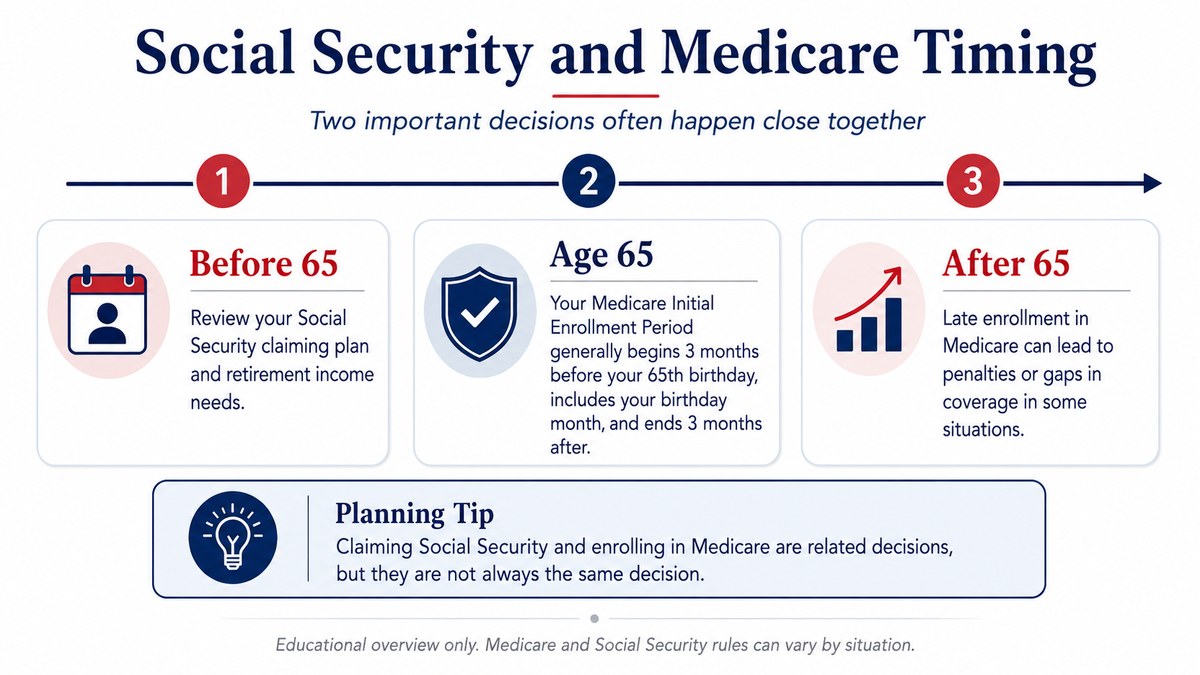
Social Security and Medicare Timing
Social Security claiming and Medicare enrollment often occur around the same stage of life, but they are separate decisions.
- Retirement benefits may begin as early as age 62
- Medicare eligibility generally begins around age 65
- Delaying Social Security does not automatically mean Medicare should also be delayed
- People covered by active employer coverage may have different Medicare enrollment considerations
- People contributing to an HSA need special attention when Medicare enrollment is approaching

The standard Medicare Initial Enrollment Period is generally seven months, but special timing rules may apply, including for people born on the first day of a month and people with qualifying current employer coverage.
Medicare enrollment rules can differ when a person has qualifying current employer coverage or other special circumstances.
This page does not attempt to reproduce the complete Medicare eligibility rules. Visit our Medicare Plans Overview for a fuller explanation of Medicare enrollment periods and coverage options.
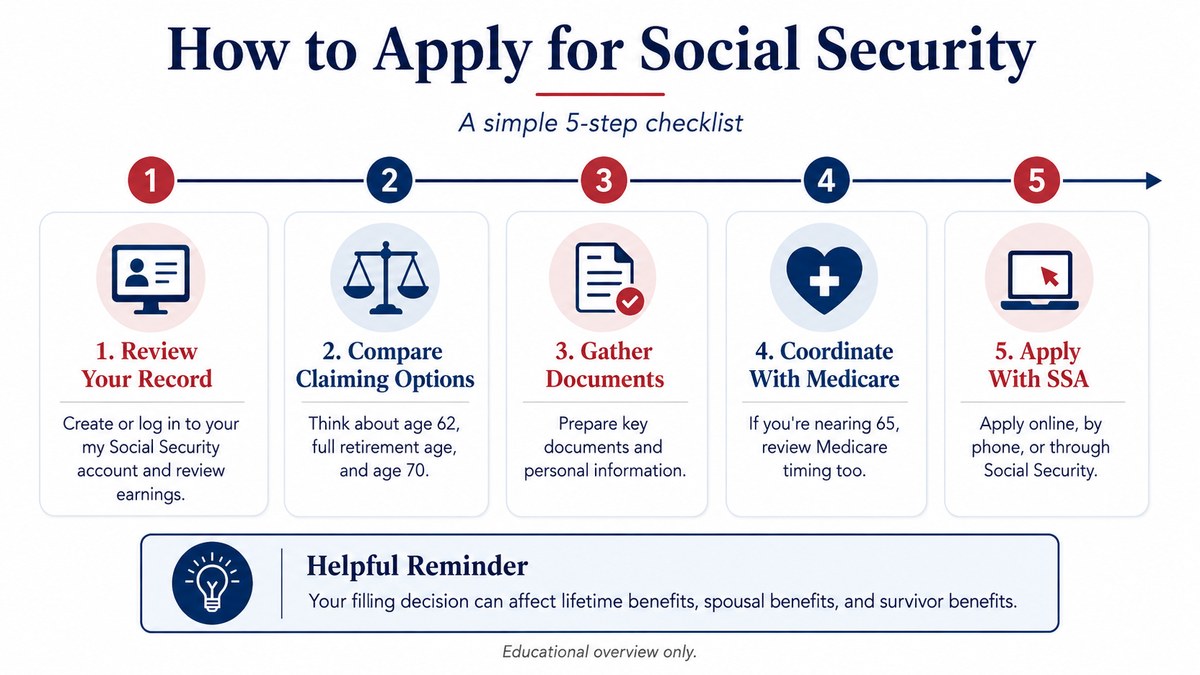
How to Prepare to Apply for Social Security
The application itself may be straightforward. The planning that comes before it can be more important.

Applications for Social Security retirement benefits are submitted directly to SSA — online at ssa.gov, by phone, or in person at a local SSA office.
Documents Generally Useful to Gather
Not every applicant will need every item listed below, and SSA may be able to verify some information electronically.
This is a general educational checklist. SSA determines the exact documentation required for your specific application — confirm current requirements directly with SSA before applying.
What If You Change Your Mind After Filing?
Withdrawal
SSA may allow you to withdraw a retirement application within its permitted 12-month window, generally with repayment of benefits and certain related amounts. A retirement-benefit withdrawal is generally limited to one time.
Voluntary Suspension
After Full Retirement Age and before age 70, a person may request voluntary suspension of retirement benefits and potentially earn delayed retirement credits during the suspension period.
Suspending benefits may also affect benefits payable to certain family members on the same work record. Review the rules before acting.
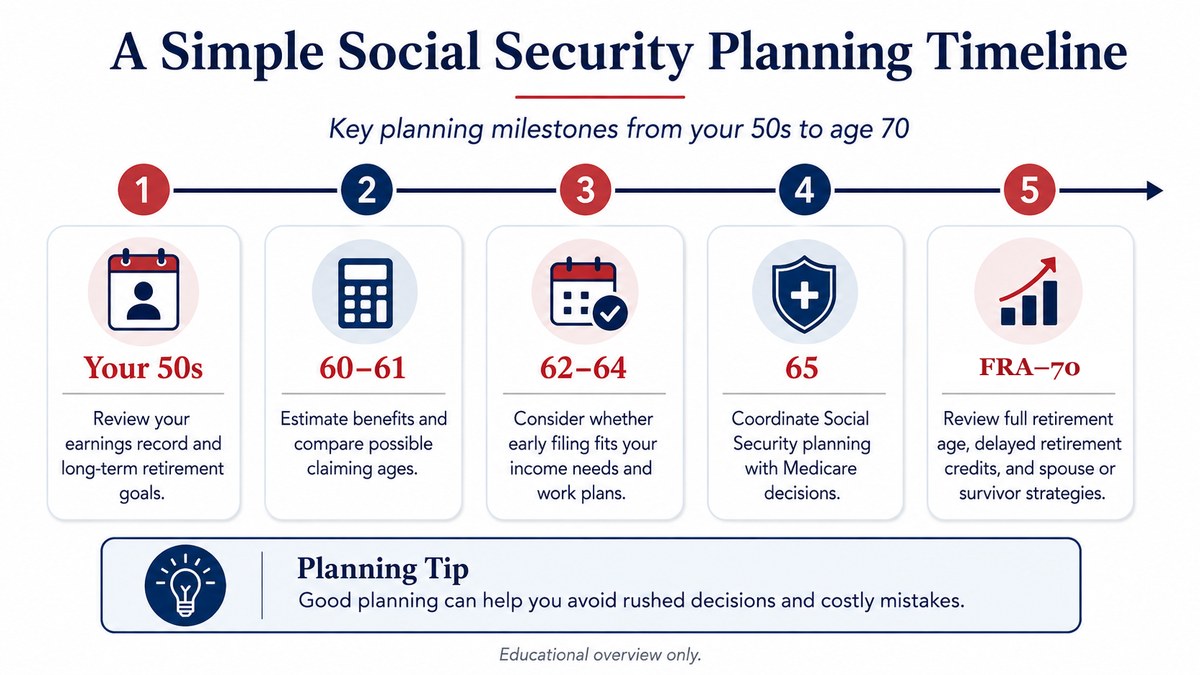
Social Security Planning Doesn't Start at 62
Social Security planning is more useful when it begins before the filing decision becomes urgent.

Common Social Security Mistakes to Avoid
Filing at 62 simply because you can
Early filing may be appropriate for some people, but understand the permanent monthly reduction before filing.
Assuming everyone should wait until 70
Waiting can increase retirement benefits, but the appropriate strategy depends on the person's circumstances.
Ignoring survivor income
For married couples, one spouse's claiming decision can affect income available to the surviving spouse.
Misunderstanding spousal benefits
Spousal benefits are coordinated with a person's own retirement benefit and are not simply added on top.
Ignoring the earnings test
Working while receiving benefits before FRA can temporarily affect payments.
Forgetting to review the earnings record
Errors or missing earnings can affect future benefit calculations.
Confusing Medicare with Social Security
Delaying one does not automatically mean delaying the other.
Using outdated information
Social Security rules and annual limits change. Make decisions using current information and your own record.
Social Security FAQs
When can I start retirement benefits?
Retirement benefits can generally begin as early as age 62 and can be delayed up to age 70. The age you choose affects your monthly benefit amount for life. SSA determines your exact eligibility and benefit amount based on your earnings record.
What is Full Retirement Age (FRA)?
FRA is the age at which you're eligible for 100% of your Primary Insurance Amount — your full, unreduced retirement benefit. Under current law it is 66 for people born 1943–1954, gradually rising to 67 for those born in 1960 or later. Your specific FRA depends on your exact birth year.
Is waiting until 70 always best?
Not necessarily. Waiting generally produces the highest possible monthly benefit, but the right choice depends on your health, family longevity, other income sources, whether you're still working, and your household's overall cash-flow needs. A personal review can help you weigh these factors rather than assuming one age is right for everyone.
Can I work while receiving benefits?
Yes, but if you claim before your Full Retirement Age and your earnings exceed SSA's annual limit, part of your benefit may be temporarily withheld under the retirement earnings test. Once you reach FRA, the retirement earnings-test limit no longer applies, and SSA generally recalculates your benefit to account for months in which benefits were withheld because of excess earnings, which can result in a higher monthly benefit going forward. Current-year earnings limits should be confirmed directly with SSA.
Can my spouse collect on my record?
A spouse may be eligible for a benefit based on your earnings record, potentially up to 50% of your Primary Insurance Amount, depending on both spouses' claiming ages and other SSA rules. This is coordinated with — not simply added on top of — the spouse's own retirement benefit, and does not reduce your own retirement benefit.
Can a divorced spouse collect?
A divorced spouse may qualify for benefits on a former spouse's record if the marriage generally lasted at least 10 years and other SSA requirements are met. This does not affect the former spouse's own benefit amount.
What are survivor benefits?
Survivor benefits may be available to a surviving spouse, and in some cases other family members, based on a deceased worker's earnings record — generally ranging from 71.5% to 100% of the deceased worker's benefit depending on the survivor's age and other SSA rules. Survivor benefit rules are distinct from spousal benefit rules.
Are benefits taxable?
Depending on your total combined income, up to 50% or up to 85% of your benefits may be included in taxable income, depending on your income level and filing status — this does not mean an 85% tax rate. Below certain thresholds, benefits are not taxed. A temporary enhanced deduction for taxpayers 65 and older is also available for 2025–2028, but it did not repeal Social Security taxation. This is general information, not tax advice; consult a qualified tax professional for guidance specific to your return.
Can you apply for me?
David can help you understand the application process, review your options, and help you prepare — including what documentation is generally needed. However, the official application, eligibility determination, and benefit calculation are handled exclusively by the Social Security Administration. Whitestone Insurance Services and David are not the Social Security Administration and cannot make eligibility determinations on SSA's behalf.
What does an RSSA® do?
A Registered Social Security Analyst® (RSSA®) is a professional credential focused on Social Security claiming education and analysis. An RSSA® helps clients understand how different claiming ages, spousal and survivor rules, and other factors may affect their Social Security income — as part of a broader retirement income conversation. An RSSA® is not employed by or affiliated with SSA and does not make official eligibility or benefit determinations; those remain the responsibility of the Social Security Administration.
Review Your Options Before You File
A Social Security claiming decision can have long-term consequences. A personal review with a Registered Social Security Analyst® (RSSA®) can help you understand the tradeoffs before you file.
Review Your Options Before You File
A Social Security claiming decision can have long-term consequences. A personal review with a Registered Social Security Analyst® (RSSA®) can help you understand the tradeoffs before you file.