
Life Insurance for Business Owners
Protect More Than a Life. Help Protect the Business Built Around It.
A business may depend on an owner, partner, executive, salesperson, manager, or other key person far more than its balance sheet shows. Life insurance can be used as part of a strategy to create liquidity when a key person dies, help fund ownership transitions, support succession planning, and provide selected executive benefits.

Your Business May Be Insured—but Is Its Most Important Person?
Businesses routinely insure buildings, vehicles, equipment, inventory, liability exposures, and workers. Yet one of the largest financial risks may be the unexpected death of an owner or another person whose relationships, knowledge, leadership, production, or expertise are difficult to replace.
Life insurance may provide cash at a time when the business is dealing with lost revenue, recruiting costs, ownership questions, lender concerns, customer uncertainty, and family obligations.
Protect the company
Create liquidity that may help the business continue while leadership or key personnel are replaced.
Protect ownership
Provide funding that may support an orderly transfer of a deceased owner's interest.
Protect the family
Help create a defined financial process instead of forcing surviving owners and heirs to negotiate during a crisis.
Protect important talent
Use selected benefit strategies to help recruit, retain, and reward valuable executives and employees.
What Happens If the Person Driving the Business Does Not Come Back Tomorrow?
A key person may be the owner or founder, a partner, the top salesperson, an executive, an operations leader, a technical expert, an employee with critical licenses, the person responsible for major customer relationships, or any individual whose departure would materially affect profits or operations.
Key person life insurance is generally owned by the business. The business pays the premiums, is typically the beneficiary, and receives the death benefit if the insured key person dies, subject to the contract and applicable employer-owned life insurance requirements.
Possible Business Uses of Proceeds
- Replace lost revenue
- Recruit and train a replacement
- Maintain payroll
- Continue rent and overhead
- Reassure lenders or creditors
- Replace specialized expertise
- Retain employees
- Support customers during the transition
- Provide time to sell, restructure, or wind down the business if necessary
Key-person valuation can consider contribution to profits, the time needed to recruit and develop a replacement, or other reasonable economic-loss approaches.
If One Owner Dies, Who Owns the Business Tomorrow?
For a business with multiple owners, the death of one owner creates two problems at the same time: the family of the deceased owner may need fair value for the ownership interest, while the surviving owners may need control of the company to continue operations.
What is a buy-sell agreement? A buy-sell agreement is a legally binding agreement that establishes how an ownership interest will be transferred after specified events such as death, disability, retirement, or withdrawal. The legal agreement must be drafted by qualified legal counsel.
A well-drafted buy-sell agreement should clearly address the parties, what is being purchased, timing, valuation, governing law, required sale and purchase obligations, update procedures, and termination provisions.
Why Funding Matters
A legal agreement establishes the obligation to buy and sell. It does not automatically create the money needed to complete the purchase.
Cash
The owners or business may use available cash, but sufficient liquid assets may not be available when an unexpected death occurs.
Borrowing
The buyer may seek a loan, but the loss of an owner or key person may occur at the same time the company's financial strength or credit profile is under pressure.
Installment Payments
The deceased owner's family may receive payments over time, which may leave the family dependent on the future performance of the business.
Life Insurance
Life insurance can create liquidity after the insured owner's death so the purchaser may have funds available to complete an agreed ownership transfer, subject to the policy and agreement.
Life insurance can provide the funding, but it does not decide who is required to sell, who is required to buy, what the business is worth, or when the transaction must occur. Those responsibilities belong in a properly drafted buy-sell or succession agreement.
Three Common Ways to Structure Life-Insurance-Funded Buy-Sell Planning
Life insurance can provide the money needed after an owner's death, but who owns the policy, who receives the death benefit, and who ultimately purchases the deceased owner's business interest depends on the structure of the buy-sell arrangement.
The three examples below illustrate common approaches. They are educational examples—not recommendations for a particular business. The appropriate arrangement depends on the number of owners, ownership structure, business value, tax considerations, succession objectives, state law, and the terms of the legal agreement.

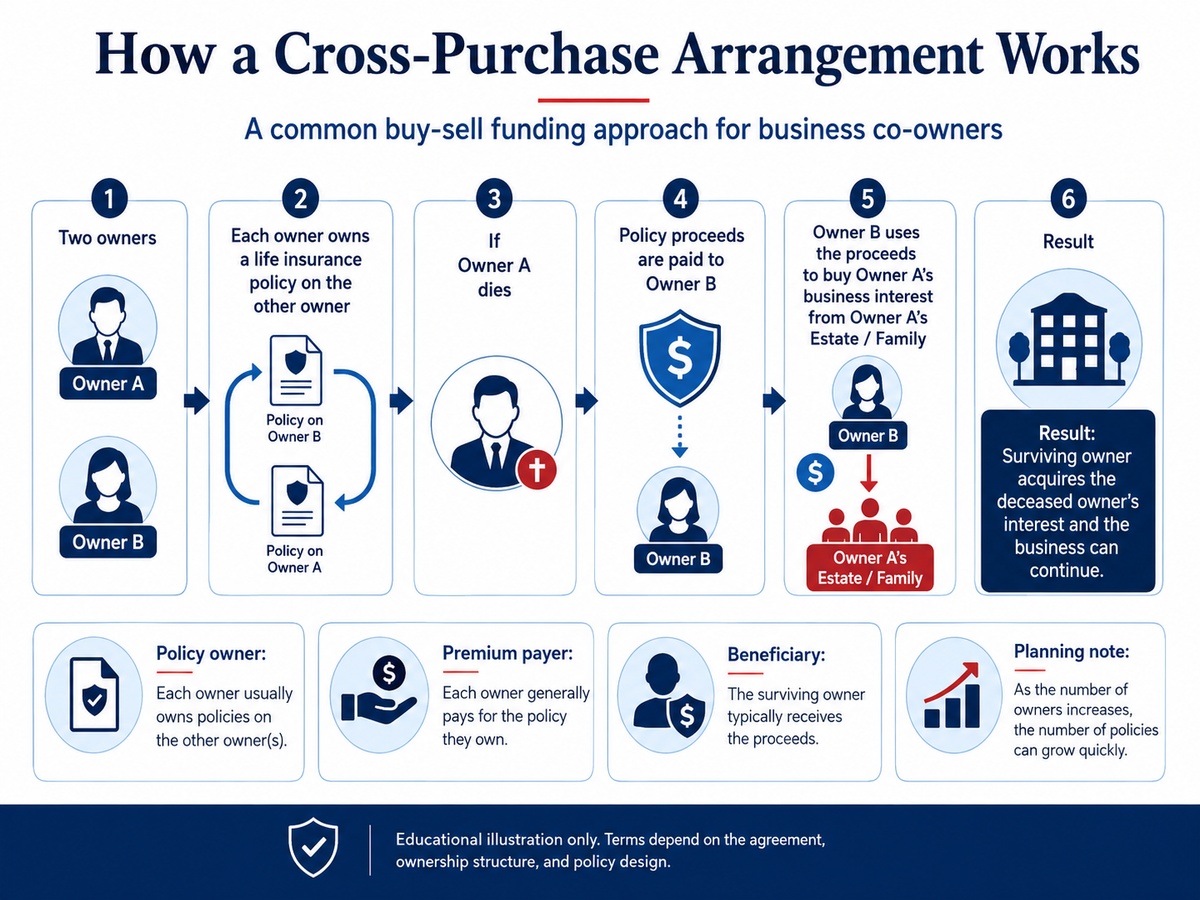
Cross-Purchase Arrangement
The owners insure one another—and the surviving owner buys the deceased owner's interest.
In a cross-purchase arrangement, the buy-sell agreement is generally between the individual business owners rather than the business itself. Each participating owner typically purchases and owns life insurance on the other owner or owners whose interests that person may be obligated to purchase.
- The owners establish a buy-sell agreementThe legal agreement identifies the triggering events, who must sell, who must buy, how the business interest will be valued, and the timing and terms of the transaction.
- Each owner obtains coverage on the other ownerIn a simple two-owner example, Owner A may own a policy on Owner B, while Owner B may own a policy on Owner A.
- Each policy owner generally pays the premiumThe owner purchasing the coverage generally pays the premium and is generally named beneficiary, subject to the specific arrangement and applicable requirements.
- One owner diesIf Owner A dies, Owner B—the surviving owner in this example—may receive the death benefit from the policy Owner B owns on Owner A.
- The surviving owner purchases the deceased owner's interestOwner B can use the insurance proceeds, together with other funds if necessary, to purchase Owner A's business interest from Owner A's estate or other applicable seller under the terms of the buy-sell agreement.
- Ownership transfersThe deceased owner's estate or beneficiaries receive the purchase consideration, while the surviving owner acquires the business interest according to the agreement.
- Policy owner
- Generally the other business owner.
- Insured
- The owner whose interest may need to be purchased.
- Premium payer
- Generally the owner of the policy.
- Beneficiary
- Generally the policy-owning business owner.
- Who purchases the business interest?
- The surviving owner or owners.
- Who generally receives payment?
- The deceased owner's estate or other seller under the agreement.
- Directly connects insurance proceeds with the person who has the purchase obligation
- Surviving owners can receive funds personally for the purchase
- Can be relatively straightforward when there are only two owners
- May support an orderly transfer without requiring the business itself to redeem the interest

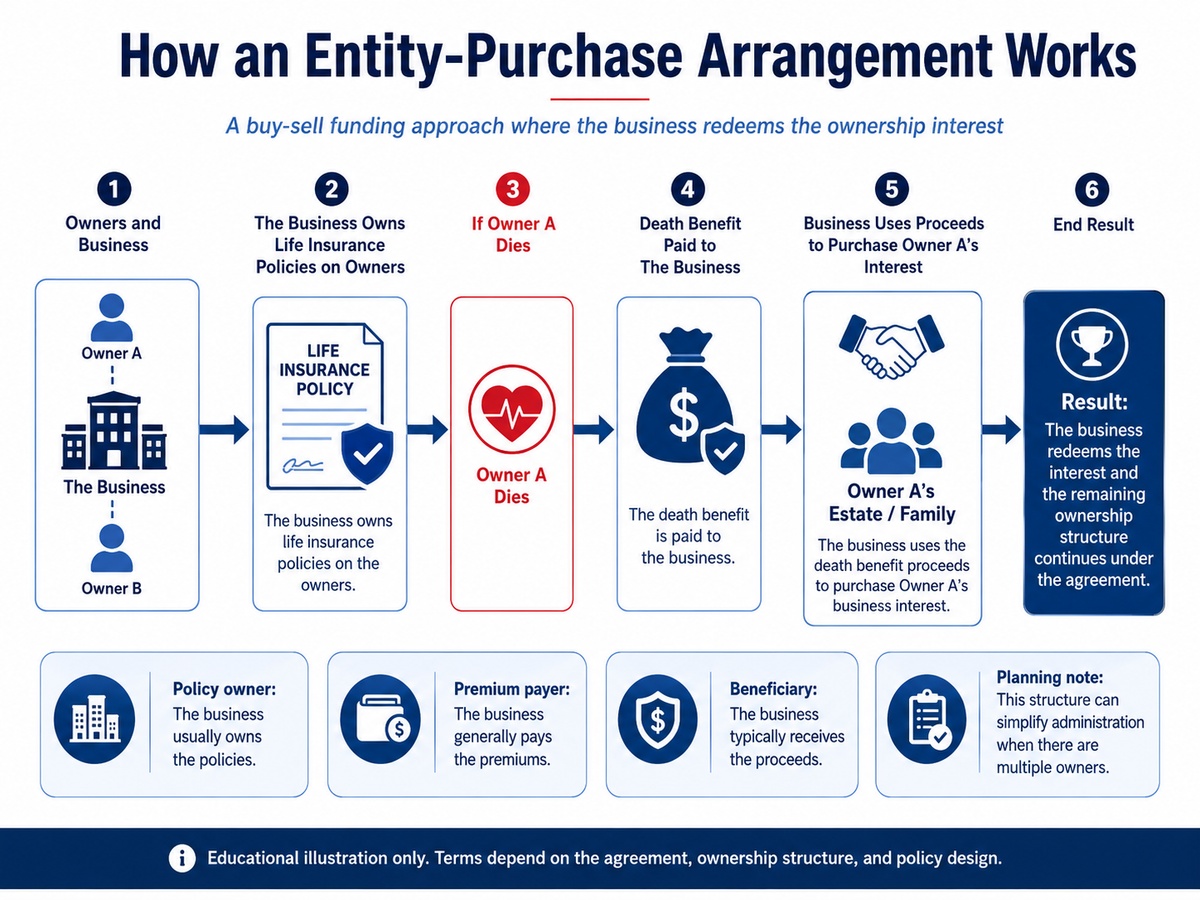
Entity-Purchase Arrangement
The business owns the policies—and the business purchases the deceased owner's interest.
In an entity-purchase arrangement, the business itself generally purchases and owns life insurance on the participating owners. Depending on the business structure, this type of buy-sell arrangement may also be referred to as a redemption arrangement. The business is typically the premium payer and beneficiary.
- The owners and business establish the agreementThe agreement specifies circumstances under which the business will purchase an owner's interest and the owner or estate will sell it.
- The business purchases life insuranceThe business generally purchases and owns a policy on each owner whose interest it may be required to redeem.
- The business generally pays the premiumsBecause the business owns the policies, it generally pays the premiums and is named beneficiary.
- An insured owner diesIf Owner A dies, the life insurance carrier pays the policy's death benefit to the business, subject to the policy and applicable requirements.
- The business purchases the deceased owner's interestThe business can use the proceeds, together with other available funds if necessary, to purchase Owner A's interest from the estate or other applicable seller at the price and under the terms established by the agreement.
- The business redeems the interestAfter the transaction, the redeemed interest is treated according to the business's governing documents and applicable law, and the remaining owners continue with the resulting ownership structure.
- Policy owner
- The business.
- Insured
- The participating business owner.
- Premium payer
- The business.
- Beneficiary
- The business.
- Who purchases the deceased owner's interest?
- The business.
- Who receives the purchase consideration?
- Generally the deceased owner's estate or other seller under the agreement.
- Centralized policy ownership
- Business manages premium payments
- Business receives the proceeds directly
- May simplify administration when multiple owners are involved
- Avoids every individual owner necessarily having to own a policy on every other owner

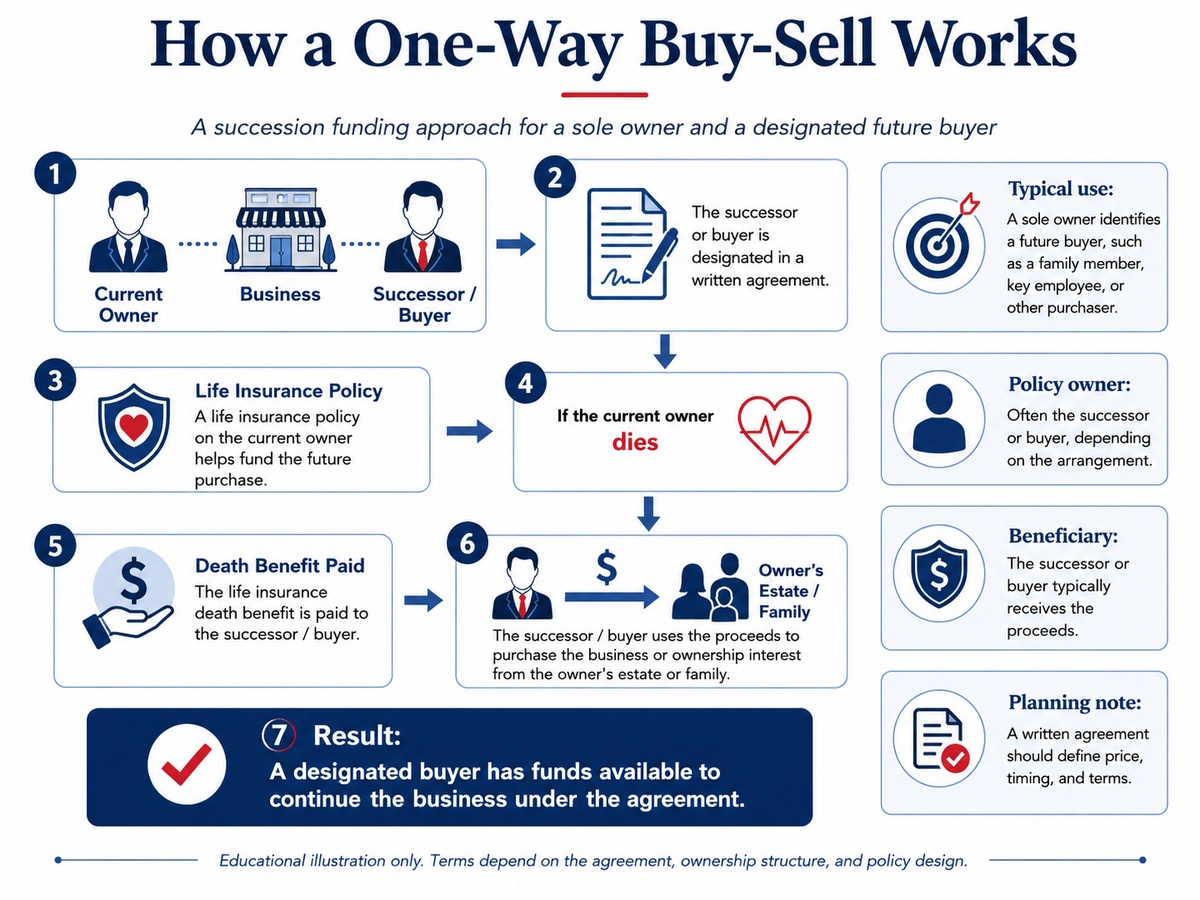
One-Way Buy-Sell Arrangement
A sole owner identifies a future buyer—and life insurance can help provide the buyer with purchase funds.
Succession planning is not only an issue for businesses with multiple current owners. A sole business owner may also want to establish who will purchase the business when the owner dies or otherwise leaves the business.
- The owner identifies a potential successorThe successor could be a key employee, family member, existing manager, friendly competitor, or other qualified buyer.
- The owner and successor establish a written agreementThe agreement should define what will be purchased, the triggering events, valuation method or purchase price, timing, payment terms, and other legal obligations.
- Life insurance is obtained on the business ownerDepending on the arrangement, the prospective successor or buyer may purchase and own life insurance on the current owner and be named beneficiary.
- The business owner diesThe event activates the applicable provisions of the succession or buy-sell agreement.
- The beneficiary receives the policy proceedsThe designated buyer generally receives the insurance proceeds from the policy that buyer owns, subject to the policy terms.
- The buyer purchases the businessThe buyer can use the insurance proceeds, together with other funding if necessary, to purchase the business or ownership interest from the deceased owner's estate or other applicable seller under the agreement.
- The succession plan is completedThe family or estate receives the agreed purchase consideration and the designated successor obtains ownership according to the legal agreement.
- Current owner
- The sole owner whose business needs a succession plan.
- Potential policy owner
- Often the designated successor or buyer, depending on the structure.
- Insured
- The current business owner.
- Potential beneficiary
- Often the successor or buyer under the arrangement.
- Who purchases the business?
- The designated successor or buyer.
- Who generally receives the purchase consideration?
- The owner's estate or other seller under the agreement.
Who Could Be a Successor?
Key Employee
A trusted employee or manager who understands the business and wants to become an owner.
Family Member
A relative who has the interest, experience, financial ability, and willingness to continue the business.
Friendly Competitor
Another business owner or company that may have strategic reasons to acquire the business.
Other Qualified Buyer
An identified purchaser with the ability and intention to complete the transaction.
Without a planned buyer, the owner's family may inherit a valuable business but have no desire, experience, licensing, employees, or liquidity needed to operate it. The estate may then need to locate a buyer while dealing with probate, creditors, employees, customers, and other estate matters.
Depending on ownership, estate planning, state law, beneficiary designations, and other circumstances, probate or estate administration may affect the transfer.
The Difference Comes Down to Who Owns the Policy and Who Buys the Interest
| Question | Cross-Purchase | Entity-Purchase | One-Way Buy-Sell |
|---|---|---|---|
| Typical situation | Multiple owners | Multiple owners | Sole owner + future buyer |
| Policy owner | Other owner(s) | Business | Often successor/buyer |
| Premium payer | Policy-owning owner | Business | Depends on arrangement |
| Beneficiary | Surviving policy-owning owner | Business | Often successor/buyer |
| Buyer of ownership interest | Surviving owner(s) | Business | Designated successor |
| Seller | Estate/other applicable seller | Estate/other applicable seller | Estate/other applicable seller |
| Primary purpose | Fund owner-to-owner purchase | Fund business redemption | Fund transition from sole owner to successor |
| Complexity as owners increase | Can increase substantially | Often more centralized | Usually focused on one owner/successor relationship |
This comparison is simplified for educational purposes. Actual ownership, beneficiary, premium, tax, valuation, and transaction structures should be determined from the specific legal agreement and coordinated with qualified legal and tax professionals.
The structure answers one question: how will the ownership transfer be funded? The next question is why planning should happen before anyone expects to need it. Even when every owner is relatively young and healthy, a business with multiple owners is exposed to the combined mortality risk of all of them.
When There Is More Than One Owner, the Risk Multiplies
Many business owners underestimate the risk because they think about a single person in isolation. But when a business depends on two or three owners, the combined probability that at least one owner dies before age 65 becomes higher as additional owners are included. The chart below shows sample combinations by age and gender and illustrates why business succession planning should not be postponed simply because each owner seems relatively young or healthy.
Odds of at Least One Owner Dying Before Age 65

Illustrative probability that at least one owner dies before age 65. Source: Commissioners 2017 Standard Ordinary Mortality Table, as presented in Global Atlantic's "What Are the Odds?" business-planning material. Individual mortality experience will vary.
- A single-owner business already faces meaningful risk if the owner dies unexpectedly.
- In a two-owner business, the chance that one owner dies is materially higher because the business depends on more than one life.
- In some three-owner examples shown in the source, the combined probability of at least one death before age 65 approaches one in four.
- The practical lesson is simple: as the number of owners increases, the need for a written agreement and a funding strategy becomes even more important.
According to the chart, a three-owner male business with ages 30–30–30 shows sample odds of one death at 23.5%. A two-owner male business at ages 30–30 shows 16.3%. These examples show why business owners should not confuse "unlikely for one person" with "unlikely for the business." Other sample combinations include a three-owner female business at ages 30–30–30 (17.0%), a three-owner male business at ages 40–40–40 (21.4%), and a two-owner male business at ages 45–50 (12.6%). Sample combinations — illustrates risk, not an individual prediction.
What Can Go Wrong If the Death of an Owner Is Not Planned For?
Ownership and Legal Problems
- The deceased owner's interest may pass to a spouse, children, or estate.
- Surviving owners may suddenly find themselves in business with heirs.
- Disputes may arise over valuation, control, and timing of a sale.
- Probate or estate administration may delay decisions.
- Lawsuits or legal conflicts may arise if expectations were never clearly documented.
Financial and Operating Problems
- The business may not have enough cash to buy the ownership interest.
- The company may need to borrow, sell assets, or delay important decisions.
- Lenders or creditors may become concerned about continuity and repayment.
- Employees and customers may leave because of uncertainty.
- In severe situations, the business may be forced to liquidate, shut down, or even face bankruptcy.
A buy-sell agreement without funding may leave the business with an obligation it cannot easily afford. Insurance funding without a written agreement may leave everyone with money but no clear legal roadmap. A coordinated plan addresses both.
How Much Is the Business Actually Worth?
A buy-sell strategy cannot be properly funded without addressing business value. A valuation established years ago may no longer reflect current revenue, earnings, assets, debt, goodwill, or market conditions.
Valuation May Consider
- Business history
- Financial condition
- Earnings capacity
- Goodwill and intangible value
- Comparable businesses
- Ownership percentage
- Marketability
- Other facts relevant to fair market value
Business valuation is not an exact science. The purchase price or formula in a buy-sell agreement should reasonably reflect fair market value when the triggering event occurs.
Life Insurance Can Help a Business Recruit, Reward, and Retain Key People
Business life insurance planning is not limited to protecting the company after someone dies. Life insurance can also be incorporated into selected executive benefit strategies designed to help a business attract, retain, and reward important employees while providing those employees with additional personal financial protection.
These arrangements are different from Key Person Life Insurance. Key Person coverage is generally designed to protect the business from the financial impact of losing an important person. Executive benefit arrangements are generally designed to provide an additional benefit to selected employees or executives.
Executive Bonus Arrangement
The business provides compensation; the executive owns the policy.
Restricted Executive Bonus (REBA)
Employee ownership, with added employer control during a defined period.
Nonqualified Deferred Compensation
The business promises future benefits, potentially informally funded with life insurance.
Split-Dollar Arrangement
An advanced arrangement dividing policy costs and benefits between employer and employee.

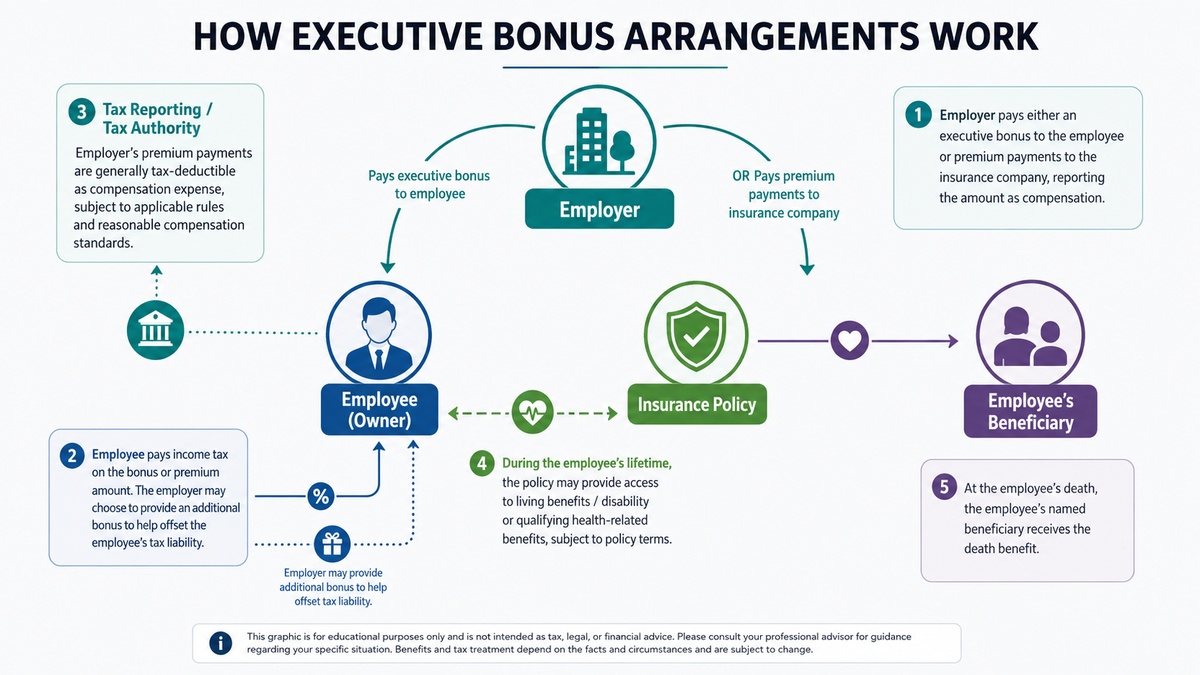
Executive Bonus Arrangement
The business provides the compensation. The executive owns the life insurance.
An Executive Bonus Arrangement—often associated with IRC §162 planning—is a strategy in which a business provides additional compensation to a selected employee or executive that can be used to help fund a personally owned life insurance policy.
The business may pay the bonus directly to the employee or may pay the policy premium on the employee's behalf while treating the amount as compensation. The employee generally owns the policy and chooses the personal beneficiary.
How an Executive Bonus Arrangement Works
- The business selects an employeeThe employer identifies an executive, manager, key employee, or other selected person it wants to reward with an additional benefit.
- The employee obtains personal life insuranceThe employee applies for and generally owns a personal life insurance policy. The employee normally chooses a beneficiary other than the business.
- The employer provides a bonusThe employer may pay a cash bonus to the employee or may pay premium amounts directly to the insurance company on the employee's behalf. The amount is generally treated as compensation to the employee.
- The employee pays applicable income taxBecause the employer's contribution is generally treated as compensation, the employee is responsible for applicable income and payroll taxes.
- The business may consider a double bonusSome arrangements provide an additional bonus intended to help offset some or all of the employee's tax cost. Whether that approach is appropriate depends on compensation design and tax advice.
- The employee owns the policy benefitsSubject to the policy terms, the employee may have access to applicable cash value, policy loans or withdrawals, and available living-benefit provisions. Loans and withdrawals can reduce policy values and death benefits, may affect policy performance, and may create tax consequences if a policy lapses or is surrendered.
- At the employee's deathThe employee's designated beneficiary generally receives the life insurance death benefit, subject to the policy terms and applicable law.
- Policy owner
- Generally the employee.
- Insured
- The employee or executive.
- Premium funding
- Employer bonus or employer-paid premium treated as compensation.
- Beneficiary
- Generally selected by the employee—not the business.
- Primary business purpose
- Recruit, reward, and retain selected talent.
Why a Business May Consider Executive Bonus
Recruit
Differentiate the compensation package when competing for important talent.
Retain
Provide an additional benefit that may increase the value of remaining with the business.
Reward
Recognize executives or employees whose performance and expertise are particularly valuable.
Select
Unlike a broad employee benefit program, an executive bonus arrangement may be designed for selected employees, subject to applicable rules.
Supplement
Provide an additional benefit alongside existing retirement plans, group insurance, and compensation arrangements.
Key Person Insurance and Executive Bonus Are Not the Same Thing
| Question | Key Person Insurance | Executive Bonus |
|---|---|---|
| Primary purpose | Protect the business | Benefit selected employee |
| Typical policy owner | Business | Employee |
| Typical premium payer | Business | Funded through employer compensation |
| Typical beneficiary | Business | Employee-selected personal beneficiary |
| Who receives death proceeds? | Business | Employee's beneficiary |
| Employee owns policy? | Generally no | Generally yes |
| Recruiting/retention purpose | Secondary | Major planning purpose |
A business can potentially have both strategies for the same important employee because they address different financial objectives, subject to underwriting, insurable-interest requirements, compensation considerations, and appropriate professional guidance.
Restricted Executive Bonus Arrangement (REBA)
Employee ownership—with additional employer control during a defined period.
Some employers like the basic Executive Bonus concept but want greater control over access to the policy while the employee remains with the company. A Restricted Executive Bonus Arrangement, or REBA, may add contractual restrictions to the arrangement.
The employee generally remains the owner of the life insurance policy and the business continues to provide the bonus. However, a special policy endorsement or related agreement may restrict certain policy actions during a defined period.
Possible Restrictions May Involve
- Loans
- Withdrawals
- Policy surrender
- Collateral assignment
- Policy ownership changes
The exact restrictions depend on the policy endorsement, written agreement, carrier requirements, and applicable law.
Why Use REBA?
The business may want the executive benefit to encourage retention instead of providing an unrestricted benefit immediately.
Executive Bonus
More employee control from the beginning.
REBA
Employee ownership, but selected policy rights may be restricted for a defined period.
Nonqualified Deferred Compensation
Promise selected executives future benefits—and potentially use life insurance as an informal funding asset.
A nonqualified deferred compensation arrangement is different from an Executive Bonus. Instead of simply giving the employee additional current compensation to fund a personally owned policy, the business enters into an agreement to provide selected future benefits.
These arrangements may be designed for selected executives or highly compensated employees and may provide supplemental retirement, death, or disability benefits, depending on plan design.
How Life Insurance May Be Used
The employer may purchase life insurance on the executive as an asset intended to help the business informally fund its future contractual obligation.
- Policy owner
- Employer/business.
- Insured
- Executive.
- Beneficiary of policy
- Generally employer/business.
- Employee benefit
- Paid according to the separate deferred compensation agreement—not simply because the employee owns the policy.
Simplified Flow
If the executive dies, the arrangement may provide a survivor benefit to the executive's beneficiary, depending on the written plan.
An informally funded nonqualified deferred compensation arrangement generally remains an obligation of the employer. Assets retained by the business may remain subject to the claims of the business's creditors.
These plans can involve IRC §409A, ERISA "top hat" requirements, employer-owned life insurance rules, creditor exposure, compensation taxation, and significant documentation requirements. They require qualified legal and tax guidance.
Split-Dollar Life Insurance
An advanced arrangement in which the employer and employee divide certain policy rights, costs, or benefits.
Split-dollar is not one specific insurance product. It is an arrangement governing how a life insurance policy's premiums, cash value, and death benefits are allocated between an employer and an employee or executive.
Depending on the structure, the employer may fund premiums and may be entitled to recover certain amounts from policy values or death proceeds, while remaining policy benefits may ultimately benefit the employee or the employee's beneficiaries.
How It Generally Works
- Employer and executive establish an agreementThe agreement defines premium responsibilities and the parties' respective interests in policy cash value and death benefits.
- Life insurance is purchasedPolicy ownership and beneficiary arrangements depend on the specific split-dollar structure.
- Employer may fund some or all premiumsThe employer's economic interest and the employee's tax treatment depend on the arrangement and applicable tax rules.
- The arrangement defines repayment or benefit rightsDepending on the design, the employer may be entitled to recover premiums or another specified policy interest, while remaining benefits may be available to the employee or the employee's beneficiaries.
Split-dollar arrangements can have complex income, gift, estate, compensation, policy-ownership, and regulatory consequences. This section is educational only and is not intended to describe every split-dollar structure.
Which Problem Is the Business Trying to Solve?
| Business Goal | Executive Bonus | REBA | Deferred Compensation | Split-Dollar |
|---|---|---|---|---|
| Reward selected employee now | Strong fit | Strong fit | Not primary purpose | Possible |
| Encourage retention | Moderate | Strong | Strong | Depends on design |
| Employee owns policy | Generally yes | Generally yes | Generally no | Depends on structure |
| Employer retains control | Limited | Greater during restriction period | Significant | Depends on structure |
| Supplemental retirement planning | Possible through policy | Possible | Primary potential use | Possible |
| Business may recover policy value/cost | Generally no | Generally no | Potentially, depending on policy ownership, plan obligations, and use of policy values | Often part of design |
| Complexity | Lower | Moderate | High | High |
This table is a simplified educational comparison. Actual plan design, ownership, taxation, policy rights, compensation treatment, and employee benefits depend on the legal documents, insurance contract, and applicable law.
Your Best Employees Are Business Assets Too
Business owners routinely invest in buildings, vehicles, equipment, technology, and marketing. Yet the people who create revenue, maintain important relationships, manage operations, or possess specialized knowledge may be even harder to replace.
Executive benefit planning can help a business compete for talent while creating additional value for the employees it most wants to keep.
Give important candidates another reason to choose your business.
Create additional value around long-term employment.
Recognize employees whose contributions materially affect the company's success.
Business life insurance can therefore serve two very different purposes: protecting the company from a financial loss and helping the company provide meaningful benefits to the people it wants to keep.
Protect the Business
- Key Person Insurance
Protect Ownership
- Cross-Purchase Buy-Sell
- Entity-Purchase Buy-Sell
- One-Way Succession
Protect and Retain Talent
- Executive Bonus
- REBA
- Nonqualified Deferred Compensation
- Split-Dollar
Business-Owned Life Insurance Has Special Rules
A business generally cannot simply purchase life insurance on an employee and assume the death benefit will receive favorable tax treatment. Employer-owned life insurance is subject to federal notice, consent, recordkeeping, and reporting requirements. For key-person coverage, the employer should provide notice, obtain written consent, own the policy, pay the premiums, and follow applicable EOLI reporting and recordkeeping requirements.
Requirements to Review Before Purchasing Business-Owned Coverage
The following are general categories of requirements that commonly apply to employer-owned life insurance. This is not a complete summary of the law.
- Insurable interest must exist
- Required notice and consent should be completed before policy issue where applicable
- IRC §101(j) requirements may apply
- Annual reporting requirements may apply
- Premium deductibility depends on arrangement and circumstances
- Policy ownership must match the intended strategy
The Death of an Owner Can Become a Business Crisis
Without a Plan
- Lost revenue
- Lost customer relationships
- Immediate recruitment expenses
- Disruption of operations
- Loan or lender concerns
- Family members unexpectedly becoming owners
- Surviving owners needing cash to buy an estate's ownership interest
- Business assets being sold to raise liquidity
- Owners borrowing at a difficult time
- Disagreement over business value
- Employees leaving because of uncertainty
- Forced or rushed sale of the company
With a Coordinated Plan
- Liquidity available to help continue operations
- Continuity for key customer relationships during transition
- Funds available to recruit or train a replacement
- A defined process instead of a crisis negotiation
- Additional liquidity that may help the business meet obligations and provide greater financial stability during the transition.
- A buy-sell agreement with an identified funding mechanism
- Surviving owners with resources to purchase the interest
- Less pressure to sell core business assets
- Less reliance on emergency borrowing
- A valuation approach agreed upon in advance
- Employees with more confidence in business continuity
- An orderly transition on the owners' terms
Life insurance does not solve every succession or continuity problem. But appropriately structured coverage can create liquidity at precisely the time cash may otherwise be hardest to obtain.
Questions Every Business Owner Should Be Able to Answer
Review the Financial Risk Around Your Business
A business life insurance review should begin with the business problem—not with a policy. Whitestone Insurance Services can help identify the insurance questions that may need to be coordinated with your attorney, CPA, valuation professional, and other advisors.
Business Life Insurance FAQs
What is key person life insurance?
It is generally life insurance owned by a business on an owner or employee whose death could create a meaningful economic loss to the company.
Who receives the benefit from key person insurance?
The business is generally the owner and beneficiary when the strategy is structured as key person coverage.
Are key person premiums tax deductible?
When the business is directly or indirectly the beneficiary, premiums generally are not deductible for federal income tax purposes, subject to applicable rules and individual circumstances. Business owners should review their situation with a qualified tax professional.
What is a buy-sell agreement?
It is a legal contract defining how ownership may be transferred after specified events such as death, disability, retirement, or withdrawal. It must be prepared by qualified legal counsel.
Why use life insurance to fund a buy-sell agreement?
Life insurance may create cash after an insured owner's death so the buyer does not have to rely entirely on existing cash, borrowing, an installment obligation, or a rushed sale of assets.
What is the difference between key person insurance and buy-sell insurance?
Key person coverage is designed primarily to help compensate the business for an economic loss. Buy-sell funding is intended to provide liquidity for an ownership transfer under a legal agreement.
What is executive bonus life insurance?
It is an arrangement in which an employer provides additional compensation that may be used to fund an employee-owned life insurance policy, subject to compensation, tax, and plan-design rules.
Can a business use life insurance for deferred compensation?
An employer may use life insurance as an informal funding asset for certain nonqualified deferred compensation obligations. These arrangements involve substantial legal, tax, ERISA, creditor, and documentation considerations.
How much key person insurance does a business need?
There is no universal formula. A reasonable analysis may consider lost profits, replacement time, recruiting expenses, debt obligations, revenue dependence, and the financial impact of losing the individual.
How often should a buy-sell plan be reviewed?
It should be reviewed periodically and after significant changes in ownership, business value, debt, profitability, or the owners' circumstances.
Schedule a Life Insurance Consultation
Choose a convenient time to speak with a licensed Whitestone agent.
You Built the Business. Make Sure There Is a Plan to Protect It.
Business continuity should not depend on everyone living, working, and remaining healthy indefinitely. A coordinated business life insurance strategy may help provide cash, time, and choices when the unexpected happens.
Life insurance coverage, premiums, cash values, death benefits, policy loans, withdrawals, guarantees, underwriting, and availability depend on the specific policy, carrier, insured, state, and contract terms. Loans and withdrawals may reduce cash value and death benefits and may increase the risk of policy lapse. Whitestone Insurance Services LLC is licensed to sell life insurance in NY, NJ, CT, PA, OH, DE, and SC.